Rapport au Ministre de la Guerre des traitements atroces qu’ont éprouvé les prisonniers français dans la Hongrie.
(Report to the Minister of War on the Atrocious Treatment Suffered by French Prisoners in Hungary)
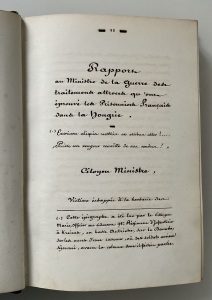 Exoriar aliquis nostris ex ossibus ultor!…
« Puisse un vengeur renaître de nos cendres ! »
(This epigraph was read by Citizen Marie, officer of the 98th Infantry Regiment, at Krems in Lower Austria, on the Danube, on the walls of a barracks where soldiers had stayed before the column of which he was part.)
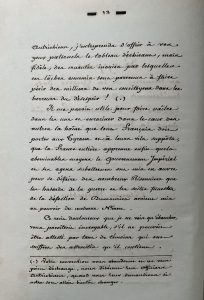
Translation of the first page of the report
A victim who has escaped Austrian barbarity, I have undertaken to lay before your paternal eyes the dreadful yet faithful picture of the unheard-of cruelties by which our unfortunate countrymen were made to perish, in the midst of your fellow citizens, in the very depths of despair. (¹)
It may be useful to awaken within you an indignation that must equally stir the heart of every Frenchman when he learns of the vile purpose to which the Imperial government and its subordinate agents resorted by the most abominable means, in order to rid themselves of the numerous prisoners whom the hazards of war—after the disastrous defection of Dumouriez—had placed in the power of this modern Nero.
The sorrowful narrative I am about to begin would seem unbelievable were it not confirmed by so many witnesses who endured the very atrocities it contains.
(¹) Our convention for exchanging prisoners having been abandoned, we asked the Austrian officers when our soldiers would be exchanged.
Historic context
The defection of General Charles-François Dumouriez in April 1793 marked one of the most stunning reversals of the French Revolution. Only months earlier he had been celebrated as the victor of Valmy and Jemappes, the savior of the young Republic; yet, confronted with the radicalization of the Revolution and the execution of Louis XVI, Dumouriez broke with the Convention, attempted to march his army against Paris, and finally passed over to the Austrians. His betrayal shattered the fragile equilibrium of the Revolutionary Wars and cast immediate suspicion on every French soldier who fell into enemy hands.
 The consequences for French prisoners of war were catastrophic. The agreements governing exchanges were abruptly abandoned. Austrian authorities, fearing further defections or subversion within their own ranks, adopted increasingly severe measures. Thousands of French soldiers captured on the Rhine, in Belgium, and along the Danube found themselves transported deep into the Habsburg territories—into Styria, Lower Austria, and the remote counties of Hungary—where they languished in barracks, fortresses, improvised depots, or forced-march columns that often resembled chains of convicts more than military captives. Many perished from hunger, disease, exposure, or direct brutality; others survived only to recount the horrors they had witnessed.
Map of the approximate route to Hungary described by Durand
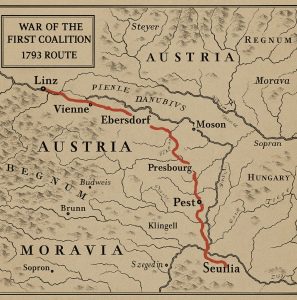 Map of the approximate route to Hungary described by Durand
 The manuscript presented here, addressed to the French Minister of War, is one such testimony. Written by a soldier who escaped what he calls “Austrian barbarity,” it is both a personal account and an act of moral accusation. Its author seeks not pity, but justice: a careful and faithful tableau of the treatment inflicted upon French prisoners in Hungary, offered to the “paternal eyes” of the Minister so that the truth might be known at last. The narrative that follows is at once sorrowful and indignant, its tone sharpened by the Latin epigraph—borrowed from Virgil—invoking an avenger rising from the ashes of the oppressed.
Without the corroborating testimony of numerous surviving prisoners, the events described might seem unbelievable. Yet they form part of a larger, now largely forgotten history: the suffering of thousands of Revolutionary-era captives whose fate was sealed not on the battlefield, but by political collapse and diplomatic rupture. This manuscript restores their voices and preserves the memory of what they endured.
The collection
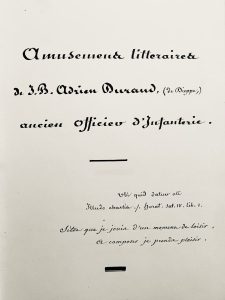
The writings of J.-B. Adrien Durand, former infantry officer and native of Dieppe, survive in a remarkable group of five uniformly bound manuscript volumes, likely copied into their present book form around 1830.
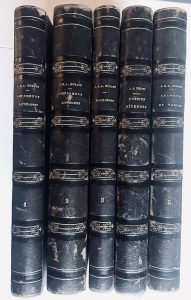
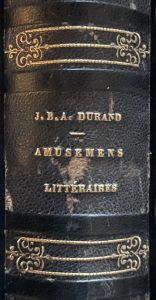
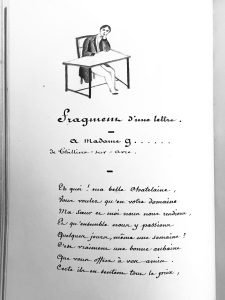 Together they present a complete record of his literary, personal, and intellectual life: poems, songs, polemics, reflections, theatrical pieces, allegories, translations, and correspondence. Each volume is carefully written in his hand, the whole forming a coherent portrait of a soldier-writer shaped by the Revolutionary era.
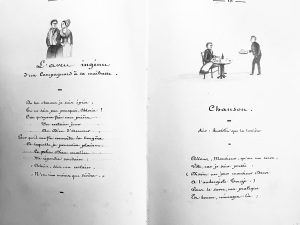 Volume II is the most historically significant of the set. It opens with Durand’s major work: a forty-five-page “Rapport au Ministre de la Guerre des traitements atroces qu’ont éprouvé les prisonniers français dans la Hongrie,” an account of the brutal conditions endured by French prisoners held in Austria and Hungary after the defection of General Dumouriez. Durand stated that he had secretly smuggled the original text out of the prison despite the vigilance of his jailers, preserving it at great personal risk. His narrative is followed by forty-six pages of related writings—letters, warnings, confessions, petitions,
 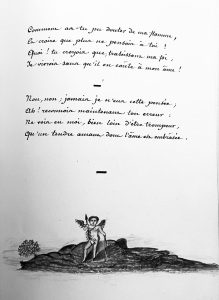 inscriptions, verses, and appeals—composed during or shortly after his captivity. These include a “Confession générale d’un prisonnier de guerre français,” a direct address “Aux peuples armés contre la France,” and a “Traduction libre d’un ordre du Major commandant la prison de Klein-Zell,” a rare documentary piece on life in the Hungarian prisons. The tone of these texts moves between patriotic indignation, personal testimony, philosophical reflection, and restrained satire, always returning to the central theme of how war and political events shaped the fate of ordinary soldiers.
 Following the prisoner writings, Durand inserted a substantial theatrical work that stands apart from the gravity of the first pages: a seventy-seven-page vaudeville titled “Le Bienfait du Divorce.” This play was written to amuse and distract his fellow prisoners, who performed or recited parts of it during their internment. It also reflects a strikingly modern subject. Divorce, introduced by the French Revolution in 1792, was a new legal right and had not existed under the Ancien Régime. Durand’s decision to create a comic work based on this radical reform—at a time when he and his companions were confined in enemy territory—underscores the mixture of resilience, wit, and political awareness that characterizes his work. The play is preceded by an “Avertissement,” followed by a dedicatory letter to his friend and fellow officer Laboissière, and then unfolds in songs, couplets, dialogues, and light theatrical scenes intended for performance among the prisoners.
 After the vaudeville, Durand continued the volume with a long and lively sequence of polemical verses under the collective title “Combat polémique.” These short pieces include satirical poems, epigrams, playful attacks on rival writers, defenses of friends, and humorous commentary on contemporary political debates. Many are addressed directly to individuals, offering glimpses into Durand’s circle and the literary culture of Revolutionary soldiers. The volume ends with translations from Latin and Italian, a statistical notice on Fécamp, an essay on the invention of playing cards, an inscription written “dans une vaste chambre,” and several final verses, completing a manuscript of exceptional range and cohesion.
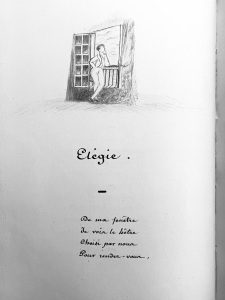
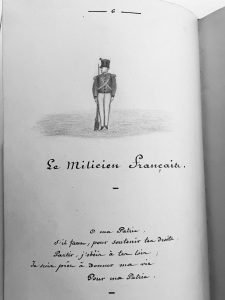
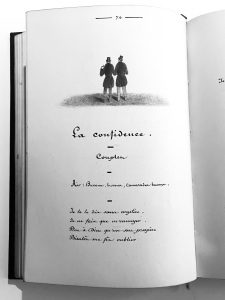
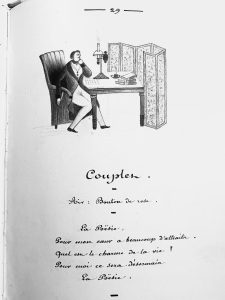
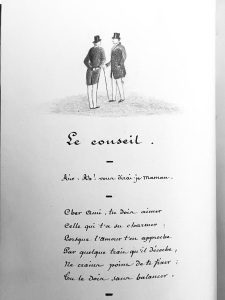
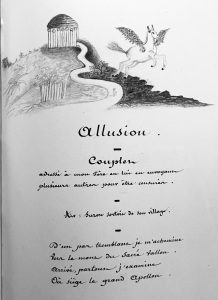 The remaining volumes—devoted primarily to poetry, songs, epigrams, and drawings—reveal the more intimate and artistic side of Durand. One volume is adorned with charming pencil and watercolor illustrations, allegorical scenes, military figures, domestic tableaux, and vignettes that accompany his verses. Many poems are set to popular airs, implying light public reading or performance. Letters addressed to Durand are copied throughout the set, and several original letters from his friend La Boissiere are loosely laid in Volume II, adding an important personal layer to the collection.
 Taken together, these five manuscript volumes form the fullest surviving portrait of J.-B. Adrien Durand. They show him as a witness of war and captivity, a writer of humor and sentiment, a translator, a musician, a playwright, and an illustrator. Few manuscript collections of theRevolutionary period survive with such breadth, personality, and unity of execution. They amount to the literary and emotional autobiography of a French officer whose voice—copied with care decades later but rooted in writings once smuggled past his jailers—still resonates with clarity and humanity.