
Volume 1 
Introduction
Durand’s recorded movements—from Lodi in December 1796 to Leoben and Klagenfurt in the spring of 1797, then through Castelfranco and Verona into Venice by November, and finally westward to Brescia—place him at the center of French civil, military, and cultural operations during a year of profound transition in northern Italy. His presence in Venice on 3 November 1797 coincides exactly with the completion of the French art seizures, providing essential historical context for the extensive list of artworks he later preserved in his manuscript.
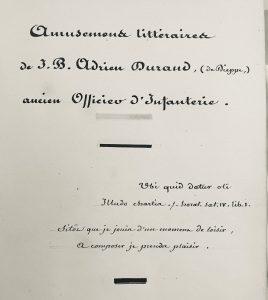
Among the manuscripts comprising this first volume of Amusemens littéraires by J.-B. Adrien Durand lies an extraordinary historical record: a French infantry officer’s eyewitness documentation of the cultural landscape of northern Italy at the very moment when Napoleon Bonaparte’s army was systematically confiscating artworks, antiquities, natural history specimens, manuscripts, and scientific collections.
Durand was not an art historian or commissioner. He was a cultivated officer with direct access to the Commission des Sciences et des Arts, moving among Italian elites while observing, at close range, the removal of their cultural patrimony. His correspondence, written between April and November 1797, traces his emotional arc from anticipation to participation to documentation, mirroring the broader trajectory of French involvement in Italy.
Spring 1797: Anticipation and Disappointment
Durand’s earliest letters from Italy—written at Leoben (20–21 April 1797) and Klagenfurt (May 1797)—reveal his longing to experience Italy’s artistic wonders. One of the most striking passages captures his disappointment:
“…Rome, Florence, Venice… I could have promised myself to pause for a moment to regard, more curious than connoisseur, the masterpieces in all genres that fill these places. But imagine, my dear friend, that instead of resting from our long fatigues, we are to be scattered across the fortified towns of the Venetian state and the Milanese. Instead of hearing, beside some pretty and spiritual woman, the enchanting music of Vinci, Pergolesi, Paisiello, we will spend our days on burning ground, repeating formation drills in clouds of dust…”
This establishes Durand as a cultivated observer, keenly aware of the artistic and musical riches around him, yet prevented by military duties from accessing them.
Summer 1797: Verona Under French Occupation
By June 1797, Durand had been transferred to Verona—one of the richest artistic centers of northern Italy and an early target for French commissioners. His letters reflect the delicate balance between his duty as an occupying officer and his admiration for the city’s culture. He formed friendships with the Spranzi and Calvi families, corresponded with scholars and clergy, and described social life, theaters, churches, and collections in vivid detail.
13 July 1797: Eyewitness to French Confiscation
Durand’s letter of 13 July 1797 (25 Messidor an 5) to Victor Daumier is one of the most important firsthand accounts of French confiscation. He writes:
“Yesterday I accompanied an artist named Blésimare, one of those appointed by the General-in-Chief to select masterpieces to enrich France. We entered the house of Doctor Barbieri, who showed us a numerous collection of petrified fish belonging to M. Ronconi, noble Florentine, deceased several months ago.
These had been taken from Monte Bolca, between Verona and Vicenza.”
This account is extraordinary. It identifies a French commissioner, a targeted collector, the material seized, and the inspection procedure. It confirms that French confiscations extended beyond art to natural history and science.
Autumn 1797: Venice and Bonaparte’s Presence
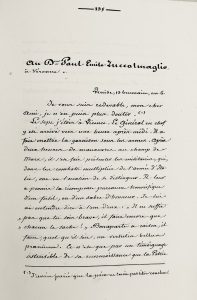
By 3 November 1797, Durand was stationed in Venice during the final moments of French occupation. He describes Bonaparte’s arrival in Vincenza near Venice:
“The General-in-Chief arrived yesterday at noon. He reviewed the troops on the Champ de Mars and presented soldiers distinguished in combat with rifles and sabers of honor… ‘It is not enough that you be brave,’ I heard him say, ‘everyone must know it!’”
This scene places Durand at the center of political and cultural events in Venice during the transition imposed by the Treaty of Campo Formio.
Durand transcribed an extraordinary passage from a speech delivered by Bonaparte in Vicenza during the spring of 1797, a moment when French authority had only just been imposed over the former Venetian territories. According to Durand, the General addressed the assembled troops with these words:
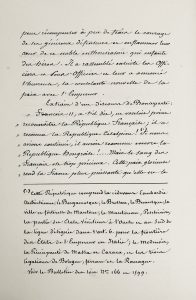
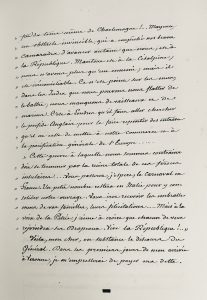
“Frenchmen! he said, you refused to recognize the French Republic; yet behold, it has recognized the Cisalpine Republic! And had we continued on this course, it would soon have recognized the Hungarian Republic as well. But the blood of Frenchmen is too precious. This glorious peace makes France more powerful than she was in the very time of Charlemagne. Mayence, that invincible obstacle which prevented our brave comrades from advancing as far as we have, now belongs to the Republic. Mantua belongs to the Cisalpine Republic; we have but one enemy left, and he is irreconcilable. It is not on the seas, nor in the Indies, that we may hope to defeat him; we lack ships and seamen. It is in London that we must go to seek out the perfidious Englishman, to make him repent of the obstacles he ceaselessly places in the way of our commerce and of the general pacification of Europe. This war, to which we are forced, must end with the total ruin of that ferocious islander. You will spend, I hope, the Carnival in France. A small number of you will remain in Italy to consolidate our work; for them, receive in advance the embraces of your families and their congratulations. But at the call of the Fatherland, I like to believe that each of you will rejoin his flag. Long live the Republic!”
Durand concludes that this represents the substance of the discourse he heard in Vicenza—an account unique today, absent from official sources, yet entirely coherent with Bonaparte’s rhetoric and strategic aims in 1797.
24 November 1797: Cultural Inventory of Verona
Durand’s letter from Brescia on 24 November 1797 is effectively a cultural inventory of Verona. He lists artworks by Titian, Veronese, Tintoretto, Guercino, and others; describes the Maffei Museum; the city’s social assemblies and theaters; and its intellectual lineage from Catullus to Fracastoro.
This letter stands as a rare snapshot of Verona at the precise moment French commissioners were evaluating and removing its treasures.
Durand’s Intellectual and Moral Position
Durand records events without explicit approval or condemnation. His tone is factual—suggesting confiscation had become normalized within military culture, even as he personally admired the art. His writings reveal the human dimension of cultural loss.
Historical Significance of the Letters
- Names individuals involved in confiscations (e.g., Blésimare)
- Describes seizure of scientific and natural history objects
- Documents Verona’s cultural landscape before French removal
- Contains details absent from official records
- Reveals how cultural plunder was justified and executed
Extraordinary Discovery: The Official French Confiscation Inventory (Rome, 1796–1797)
Durand’s manuscript contains a complete transcription of the official French government inventory of artworks and antiquities confiscated from Rome and the Vatican under the Armistice of Bologna (20 June 1796) and the Treaty of Tolentino (19 February 1797). This list would form the foundation of the Musée Napoléon (now the Louvre).
Complete list of confiscated Artworks
Conclusion
Durand’s letters and the unofficial inventory together form the most complete surviving picture of the French confiscation of Italian art during the campaign of 1796–1797. They trace a progression from expectation to participation to documentation, revealing both the machinery of occupation and the fragile cultural worlds caught within it.
Through these documents, Durand becomes an indispensable witness to one of the most significant episodes of cultural displacement in European history.