
The collection
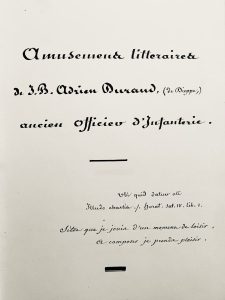
The writings of Jean Baptiste Adrien Durand (1767-1834), former infantry officer and native of Dieppe, survive in a remarkable group of four uniformly bound manuscript volumes, organized and copied in the mid nineteenth century from Adrien’s earlier papers by his son Jules Adolphe Durand (1801-1882).
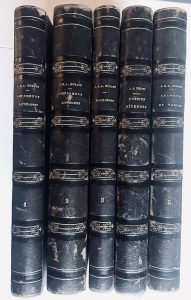
Durand died at Fécamp in 1834. His son, Jules Adolphe Durand (born at Fécamp on 16 June 1801), is directly associated with the surviving four manuscripts. A note in the volume bearing Adolphe’s name refers to the death of his wife, Émilie Gingois, confirming his role in either preparing or transmitting the material. Both the internal reference to Émilie Gingois and the handwriting indicate that Jules Adolphe Durand copied or arranged the extant texts, working from his father’s earlier papers. The four volumes—numbered 1, 2, 3, and 5—are uniformly titled J. L. A. Durand Amusemens Literaires. There is a fifth volume, titled J. A. Durand Poesies Diverses that is entirely the work of Adolph.
Volume 4 is missing, presumably containing writings between 1800 and the time Adrien died in 1834. We make this assumption on account that little is written about his married life and his spouse. The missing volume may have been kept by the descendants.
No statements in the manuscript identify any other contributors, and the narrative itself consistently attributes the events described to Jean-Baptiste Adrien Durand, all bear the same title on the spine and start with the same title page identifying Adrien as the author.
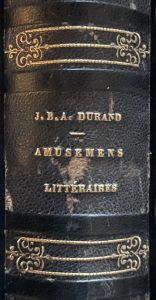
Together they present a complete record of his literary, personal, and intellectual life: poems, songs, polemics, reflections, theatrical pieces, allegories, translations, and correspondence. Each volume is carefully transcribed by his son, the whole forming a coherent portrait of a soldier-writer shaped by the Revolutionary era.
Volume I, strangely out of chronological order, situates J.-B. Adrien Durand at the very heart of the French occupation of northern Italy, after his release from captivity, during one of the most consequential cultural episodes of the Revolutionary Wars: the systematic seizure of Italian artworks and scientific collections in 1797. Far from being a passive observer, Durand moved through the same cities, corridors of power, and intellectual circles as the French commissioners tasked with selecting objects for transport to Paris. His letters, composed as he followed the shifting front from Lombardy to the Adriatic and back toward the Venetian mainland, offer an unusually intimate perspective—neither administrative nor propagandistic—on how a reflective, educated officer perceived the unfolding cultural expropriation. What follows traces, through his letters, Durand’s itinerary, his encounters with scholars, collectors, and artists, and his gradual realization that he was witnessing not merely military occupation but the transformation of Italy’s cultural landscape.
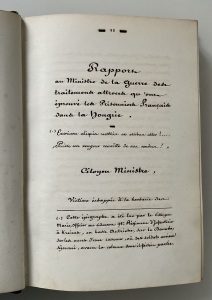
Volume II is the most historically significant of the set. It opens with Durand’s major work: a forty-five-page “Rapport au Ministre de la Guerre des traitements atroces qu’ont éprouvé les prisonniers français dans la Hongrie,” an account of the brutal conditions endured by French prisoners held in Austria and Hungary after the defection of General Dumouriez. Durand stated that he had secretly smuggled the original text out of the prison despite the vigilance of his jailers, preserving it at great personal risk. His narrative is followed by forty-six pages of related writings—letters, warnings, confessions, petitions,inscriptions, verses, and appeals—composed during or shortly after his captivity. These include a “General Confession of a French Prisoner of War” a direct address “To the Peoples Armed Against France.” and a “Free Translation of an Order Issued by the Major Commanding the Prison of Klein-Zell.” a rare documentary piece on life in the Hungarian prisons. The tone of these texts moves between patriotic indignation, personal testimony, philosophical reflection, and restrained satire, always returning to the central theme of how war and political events shaped the fate of ordinary soldiers.
The remaining volumes—devoted primarily to poetry, songs, epigrams—reveal the more intimate and artistic side of Durand. Many poems are set to popular airs, implying light public reading or performance. Letters addressed to Durand are copied throughout the set, and several original letters from his friend Laboissiere are loosely laid in Volume II, adding an important personal layer to the collection as it came directly from the inherited archive.
Taken together, these four manuscripts volumes form the fullest surviving portrait of J.-B. Adrien Durand. They show him as a witness of war and captivity, a writer of humor and sentiment, a translator, a musician, a playwright. Few manuscript collections of the Revolutionary period survive with such breadth, personality, and unity of execution. They amount to the literary and emotional autobiography of a French officer whose voice—copied with care decades later but rooted in writings once smuggled past his jailers—still resonates with clarity and humanity.
Volume one:
Unpublished manuscript of Adrien Durand, French prisoner of war in Hungary in 1793
Volume five
Adrien Durand: Clarified Chronology of Captivity, Italian Journey, and Later Writings