
Military exploits of Prince Maurice of Nassau, 1st ed. in French; the Fairfax–Osterley Park copy, with first-person marginal notes on the Cadiz action of 1596 and the siege of Ostend, identified as Sir Walter Raleigh’s autograph by William Oldys in his Life of Ralegh (1736).
Jan Jansz ORLERS
Description & Representation de toutes les Victoires tant par eau que par terre, lesquelles Dieu a octroiees aux nobles, hauts & puissants Seigneurs, Messeignrs les Etats des Provinces Unies du Païs-bas, souz la conduite & gouvernement de son Excellence, le Prince Maurice de Nassau. Leiden: par Jean Jeanzoon Orlers & Henry de Haestens, 1612.
Folio (12 1/4 x 8 inches; 311 x 203mm). Pp. [iv], 282 pp. Half-title (“Les Lauriers de Nassau”). Letterpress title with elaborate engraved surround, the verso with a full-page engraved plate of Prince Maurice of Nassau’s coat-of-arms, faced by a full-page engraved portrait of the Prince (the portrait bearing the printer’s pencil crop-masks from its reproduction as the frontispiece of Nutting, 1894, see below). 43 double-page or folding engraved maps and plates (The destruction of the Spanish armada plate with heavy old ink-staining, lighter staining to the four following text leaves, some other spotting, about 5 plates with splits to the central folds, one heavily toned). Contemporary calf over pasteboard, the covers with large central arabesque plaque blocked in gilt, the borders ruled in gilt and blind, old re-backing with red morocco spine label (extremities worn, the upper joint split, some strengthening of the inner joints; bound without pastedowns, as usual in bindings of this period, the period free blanks preserved and bearing the inscriptions and press-marks described below, later flyleaves added at the re-backing).
The hands in this copy
Two principal annotating hands, of distinct dates and characters, are present, together with the pen-trials and signatures of earlier owners and the pencil memoranda of a later one.
I. The annotator. The earliest hand is an informal English italic of the early seventeenth century, writing a soldier’s phonetic French (prix for pris, refuse for refus, pardu for perdu). Its notes cluster on the chapters describing the Anglo-Dutch descent on Cadiz in June 1596 — the action in which Sir Walter Raleigh, commanding the Warspite, led the fleet into the harbour — and they are written not as a reader’s observations but as a participant’s claims, in the first person. Beside the passage describing Raleigh (“Ravvleyg”) requesting the charge of taking the Spanish Indies fleet, asking only his own ship and twelve London merchantmen, and being put off by the Generals until the morrow: en lequelle ils m’ont trompé; par la refuse nous avons pardu 2 millions (“in which they deceived me; by the refusal we lost 2 millions”) — the two-million-ducat ransom offered for the flota, refused, after which the Spaniards fired their own fleet. The word pardu is itself a witness to composition: first botched and blotted wet in the line, it is keyed with an asterisk and rewritten below at a matching mark — the writer correcting his pen, and retaining, at leisure, his own phonetic spelling.

Beside the resolution of Howard and Raleigh to attack the galleons: a moy seule (“to me alone”).
Beside the account of the great galleons San Mateo and San Andrés, carried off as prizes: Je ay prix tous deux (“I took both of them”).

Beside “le Lord Thomas Havvard Vice-Admiral, prés de Sire VValter Ravvleyg”: mais bien arrière (“but well astern”) — echoing the grievance that runs through Raleigh’s own Relation of the Cadiz action, that he led in and the rest came up behind.

The printed count of 57 great ships in the Bay of Cadiz is corrected in the margin to 67.

—— a figure agreeing with no printed account of the action, and, with the Ostend notes, among the annotations unrecorded by Oldys, who canvassed the conflicting ship-counts in a dedicated note without knowledge of the margin’s ruling.
The same hand annotates the account of the siege of Ostend. Where Orlers rehearses the governors of the town who fell in succession — Gistelles killed in March, Loon who “fut aussi tué,” Berendrecht, Utenhove carried out wounded, Marquette arriving in June 1604 — the annotator supplies, in the same soldier’s French, the commander the chronicler omitted: Coll: Charles Fairfax fut Governeur, et fut aussi tué (“Colonel Charles Fairfax was Governor, and was also killed”) — Sir Charles Fairfax having been killed commanding the English companies at Ostend on 17 September 1604, three days before the town fell.

The same hand returns at the death of the Comte de Chastillon (fol. 224), struck down by a cannon-shot on the Sand Hill on 10 September 1601, the debris flying in the faces of Huchtenbroeck, Captain Brog “& de quelques autres” — against which the margin supplies: et de Cap: Charles Fairfax Chevalier (“and of Captain Charles Fairfax, knight”).
Twice, then, the annotator names Charles Fairfax with particulars beyond his chronicler — whether from the printed siege literature or from the returning eyewitnesses who filled London, and later the Tower itself, where the Earl of Northumberland, named on this very page of Orlers among the siege’s visitors, was Raleigh’s daily companion through the years these notes were made.

The internal evidence thus identifies the annotator, if he is to be taken at his word, with one man only: the deceptions, the lost ransom, the two captured galleons, and the precedence in the harbour are the documented grievances and claims of Raleigh himself, and of no other officer at Cadiz. The chronology is coherent: the book appeared in 1612, while Raleigh sat in the Tower of London (1603–1616) with a substantial working library, six years before his execution; the notes, if his, record a prisoner rereading a Dutch chronicler’s account of his greatest action and setting down his corrections. The identification is, moreover, not new. William Oldys, in the standard eighteenth-century Life of Ralegh prefixed to the 1736 folio of the History of the World, describes and quotes these very notes: a copy of the Lauriers de Nassau “falling into his hands soon after it was published,” Raleigh “has, in the language it is writ in, made short notes with a black-lead pencil throughout this whole action, where himself is mentioned; which are not only still legible, but demonstrable to be his own writing, both from the sense and form of the characters.” Oldys prints A moy seul, Mais bien arrière, and J’ay pris tous deux (“it appears under his own handwriting that he took them both himself”), and records that “this curiosity” was then in the possession of Thomas Brian, esq., of the Inner Temple, who lent him the notes. The notes in the present copy stand in ink — fluent, shaded, self-correcting ink, with a botched word blotted wet and rewritten at an asterisk, the antithesis of writing traced over a pencil original — so that Oldys’s “black-lead pencil” appears to describe not the book itself but the form in which the notes reached him, Thomas Brian having “favoured me with the use of those notes,” a phrase as consistent with a lent transcript as with the volume — a reading reinforced by Oldys’s ignorance of the corrected ship-count, a silent numeral alteration such as an extract of the verbal notes would naturally omit; it is the single point of his description not borne out by the copy.
Neither Ostend note is recorded by Oldys, who understood the annotations to be confined to the Cadiz action ‘where himself is mentioned’ — they appear to be published here for the first time.
The attribution, resting since 1736 on the authority of the century’s foremost Raleigh scholar, who examined the notes themselves and pronounced them autograph from the sense and form of the characters, awaits modern palaeographic comparison with Raleigh’s autograph Tower notebook (British Library, Add. MS 57555).
II. The Fairfax family hand. A second, later seventeenth-century hand writes in English, and its concern is genealogical. On the first period blank it has indexed the volume: Sr Charles Fairfax. p.199. At folio 199 — the order of battle of the Nieuwpoort campaign, the English regiment of thirteen companies under Sir Francis Vere — the same hand identifies three names in the margin: “Sr Fr: Vere” against the general, “Sr Charles Fairfax” against the company the printer garbled as “de Farfax,” and “Sr Horatio Vere” against the regiment of Sir Horace Vere. At the account of Vere’s parley at Ostend of 23 December 1601, when “le Capitaine Ogle, Lieutenant Colonel, & le Capitaine Fairfax” were sent as hostages to the Archduke’s camp, the same hand glosses the margin: Sr Charles Fairfax, brother to ye first Lord Tho: F.

The formula “the first Lord” dates the notes: it presupposes a second Lord Fairfax, and was most naturally written after 1648, when “Lord Thomas Fairfax” meant to every English reader the Lord General. The hand is entirely distinct from that of the French notes; it is the hand of a family reading its own history in the margins of another man’s book, and it records a Fairfax association with the volume in the seventeenth century, before its documented residence in other hands and its later return to a Fairfax library.
III. Earlier owners. Pen-trials and signatures of the seventeenth century on the endleaves record the volume’s passage between its annotator and its later owners: the name Josephus Acosta written out four times (once with the date 1562); Captaine Clarke; a cancelled George; and the schoolroom tag Si deus est animus, the opening of Cato’s Distichs. The military style of address suggests at least one soldier-owner among them.


Provenance
This copy carries a paper trail of more than two centuries through the scholarship and the great libraries of England, and the physical evidence of that history survives on the period blank endleaves and in the margins themselves.
The seventeenth-century glosses of the Fairfax family hand record the volume’s earliest English association: Sir Charles Fairfax (c.1567–1604), fourth son of Sir Thomas Fairfax of Denton and brother of Thomas, first Lord Fairfax, served under Sir Francis Vere in the Low Countries, rallied the English companies at Nieuwpoort, went as hostage and fought in the breach at Ostend, routed Velasco’s troops at the siege of Sluis, and was killed commanding the English companies at Ostend three days before the town fell — campaigns this volume chronicles, and in the margins of which the annotator had already twice set down his name.
The copy enters the scholarly record in the possession of Thomas Brian, esq., of the Inner Temple, who lent its marginal notes to William Oldys for the Life of Ralegh (published 1736, the sheets in print by 1733), where Oldys declared them Raleigh’s autograph and the volume Raleigh’s own copy, acquired soon after publication. By what channel it passed from Brian to the Fairfax library is not yet traced; it had done so by the death of Brian Fairfax the younger (1676–1749), commissioner of customs, appearing as lot 945 in the catalogue printed by Prestage for the auction of his library beginning April 26, 1756 — a bare entry (“Description des Victories de Maurice de Nassau, Leyd. 1612”), silent on the manuscript notes, standing on the family’s Low Countries shelf a few lots from Sir Francis Vere’s Commentaries (lot 954), the memoir of the very commander under whom Charles Fairfax served. That auction never took place: the entire Fairfax library was purchased beforehand by the banker Francis Child (1735–1763) and installed at Osterley Park, Middlesex.

Curiously, the volume then passed briefly through the London trade — most plausibly released as a cull or duplicate after Child’s wholesale purchase. On Thursday, February the 7th, 1760, the booksellers L. DAVIS and C. REYMERS opened the sale, at their Great Room against Gray’s Inn Gate, Holborn, of “A Catalogue of about Four Thousand Volumes, lately purchased” — not an auction but a fixed-price catalogue, the lowest price of each book printed. This copy appears as lot 1416, priced at 10s 6d, the notes named and attributed as Oldys’s printed Life had identified them:

1416 Les Lauriers de Nassau, avec fig. with some MS. marginal notes by Sir W. Raleigh, 10s 6d, Leyden, 1612
The cataloguer’s confidence is thus explicable: the identification had stood in print for twenty-four years, in the most authoritative Life of Raleigh of the age — and it is the same identification the internal evidence of the Cadiz passages makes on its own.
The volume’s absence from Osterley was brief: by 1771 it stood again on the Osterley shelves, recorded (“Le Lauriere de Nassau — 1612”) at press-mark X.1.3.9 in the privately printed Catalogus Librorum in Bibliotheca Osterleiensi compiled by Thomas Morell — entered, notably, in the catalogue’s Appendix (Classis Decima, Libri Miscellanei), among the books shelved outside the main classified arrangement, as a volume restored to the library after that arrangement was settled would be. Both that press-mark and an earlier, cancelled mark reading II.2.Pr.9 survive in ink in this copy, fixing its identity with the Morell record beyond question. The cancelled mark is written in the catalogue’s own notation for a separate piece of library furniture, “The Press” (its shelf-lists printed in the form II.2.1, II.2.2 &c., and its abbreviation “Pr.” used in cross-references such as “[Pr. 36. X.1.2.28]”): the book stood first in the Press, case II, shelf 2, ninth book, and was re-shelved into the Appendix at X.1.3.9, its old address struck through — an institutional two-address pattern the printed catalogue itself documents for other volumes (the Bembo at II.2.10 carries the bracketed alternate address “II. 1. Pr. 8”, in the very notation of this copy’s cancelled mark), and one consistent with a book restored to the library after the main arrangement was settled. The printed list of the Press’s case II, shelf 2 shows its ninth place occupied by another work, the present volume having already removed to the Appendix by the time the catalogue was set. There it remained for more than a century, descending with the library to Victor Child Villiers, 7th Earl of Jersey, until the dispersal of the Osterley Park Library by Sotheby, Wilkinson & Hodge over eight days beginning May 6, 1885, where it was lot 1187, sold to Bernard Quaritch for 12 shillings. Quaritch offered it the following month in his rough list of the choicer portion of the Osterley library, item 145, at one pound.
The copy then crossed the Atlantic. On the rear board are the pictorial bookplate of George Hale Nutting (1867–1957), of the Nutting family of Groton, Massachusetts — its design commemorating John Nutting, killed defending Groton in March 1675/6, and the family’s Revolutionary service — and the later armorial plate of one Andrew Stewart. The Nutting ownership is documented by the last item in the references below: the portrait frontispiece of Mary Olivia Nutting’s Days of Prince Maurice (Boston, 1894) was reproduced from the engraved portrait of the Prince in this copy, the printer’s pencil crop-masks of c.1893–94 remaining on the plate — placing the volume in New England, in the family’s possession, within a decade of the Osterley sale.
Litt:
William Oldys. The Life of Sir Walter Ralegh, prefixed to Raleigh, The History of the World. London: 1736 (quoting the marginalia, then in the possession of Thomas Brian, esq., of the Inner Temple, and pronouncing them Raleigh’s autograph); reprinted in W. Raleigh. The Works… now first collected. Oxford: 1829. Vol.I p.245, etc.
Walter Oakeshott, ‘Sir Walter Ralegh’s Library’, The Library, 5th Ser. 23 (1968), pp. 285-327.
Peter Beal (ed.). Catalogue of English Literary Manuscripts 1450–1700 (CELM), Introduction to Sir Walter Ralegh: recording this volume, from Oldys’s citations, as an “unlocated volume” whose authenticity is “not impossible” — here located.
British Library, Add. MS 57555 (Sir Walter Raleigh’s autograph notebook of the Tower years, with the list of his library).
Ref:
Prestage (auctioneer). A Catalogue of the … Library of … Bryan Fairfax… 1756. London: [1756] lot 945
L. Davis and C. Reymers (booksellers). A Catalogue of about Four Thousand Volumes, lately purchased… London: [1760] lot 1416
[Thomas Morell]. Catalogus Librorum in Bibliotheca Osterleiensi. [London?:] 1771. Appendix, Classis Decima (Libri Miscellanei), shelf mark X.1.3.9 (“Le Lauriere de Nassau — 1612”)
Sothebys (auctioneer). The Osterley Park Library. Catalogue …, the property of… the Earl of Jersey : which will be sold by auction… on Wednesday, the 6th day of May, 1885, and seven following days. [London:] 1885. Lot 1187 (sold to Bernard Quaritch for 12 shillings).
Bernard Quaritch. A rough list … including the choicer portion of Osterley Park library… [London: June 1885]. Item 145 (asking price 1 pound).
Mary Olivia Nutting. The Days of Prince Maurice. Boston & Chicago: 1894. See the portrait frontispiece (reproduced from this copy).
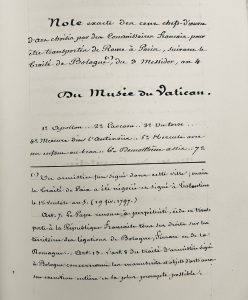 1st Apollo… 2nd Laocoön… 3rd Torso… 4th Mercury called the Antinous… 5th Hercules with a child in his arms… 6th Demosthenes seated…
 7th Trajan seated… 8th Menander seated… 9th Posidonius seated… 10th A warrior, called the Phocion… 11. Ariadne called the Cleopatra… 12th Two cupids, half-figure… 13th A Philosopher believed to be Sextus of Chaeronea… 14th Health… 15th Juno… 16th Venus crouching… 17th Adonis…18 Paris… 19th Discobolus… 20th Another Discobolus…21 Bearded Bacchus, called the Sardanapalus…22. Augustus 23rd A veiled Roman… 24th The Cybele of Capri. 25th Meleager… 26: & 27 The Nile and the Tiber, colossal figures… 28th Ceres, colossal… 29th Melpomene same… 30th Apollo musagetes…31 to 39th The nine Muses found at Tivoli… 40th A small seated Urania… 41st A small Clio.