An Officer’s Witness: J.-B. Adrien Durand and the French Confiscation of Italian Art and Cultural Treasures, 1797

Volume 1
Introduction

Durand’s recorded movements—from Lodi in December 1796 to Leoben and Klagenfurt in the spring of 1797, then through Castelfranco and Verona into Venice by November, and finally westward to Brescia—place him at the center of French civil, military, and cultural operations during a year of profound transition in northern Italy. His presence in Venice on 3 November 1797 coincides exactly with the completion of the French art seizures, providing essential historical context for the extensive list of artworks he later preserved in his manuscript.

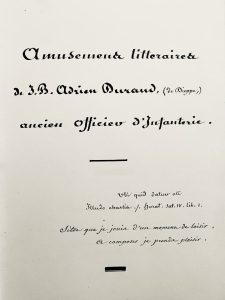
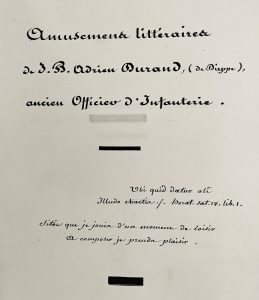
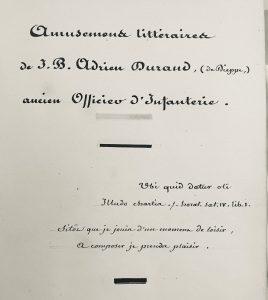
Among the manuscripts comprising this first volume of Amusemens littéraires by J.-B. Adrien Durand lies an extraordinary historical record: a French infantry officer’s eyewitness documentation of the cultural landscape of northern Italy at the very moment when Napoleon Bonaparte’s army was systematically confiscating artworks, antiquities, natural history specimens, manuscripts, and scientific collections.

Durand was not an art historian or commissioner. He was a cultivated officer with direct access to the Commission des Sciences et des Arts, moving among Italian elites while observing, at close range, the removal of their cultural patrimony. His correspondence, written between April and November 1797, traces his emotional arc from anticipation to participation to documentation, mirroring the broader trajectory of French involvement in Italy.

Spring 1797: Anticipation and Disappointment

Durand’s earliest letters from Italy—written at Leoben (20–21 April 1797) and Klagenfurt (May 1797)—reveal his longing to experience Italy’s artistic wonders. One of the most striking passages captures his disappointment:

“…Rome, Florence, Venice… I could have promised myself to pause for a moment to regard, more curious than connoisseur, the masterpieces in all genres that fill these places. But imagine, my dear friend, that instead of resting from our long fatigues, we are to be scattered across the fortified towns of the Venetian state and the Milanese. Instead of hearing, beside some pretty and spiritual woman, the enchanting music of Vinci, Pergolesi, Paisiello, we will spend our days on burning ground, repeating formation drills in clouds of dust…”

This establishes Durand as a cultivated observer, keenly aware of the artistic and musical riches around him, yet prevented by military duties from accessing them.

Summer 1797: Verona Under French Occupation

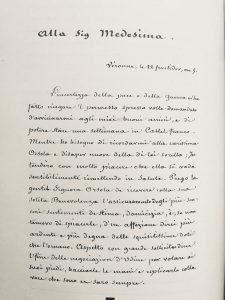
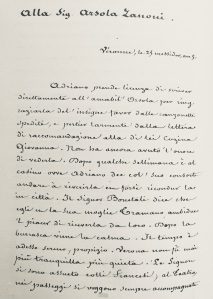
By June 1797, Durand had been transferred to Verona—one of the richest artistic centers of northern Italy and an early target for French commissioners. His letters reflect the delicate balance between his duty as an occupying officer and his admiration for the city’s culture. He formed friendships with the Spranzi and Calvi families, corresponded with scholars and clergy, and described social life, theaters, churches, and collections in vivid detail.

13 July 1797: Eyewitness to French Confiscation

Durand’s letter of 13 July 1797 (25 Messidor an 5) to Victor Daumier is one of the most important firsthand accounts of French confiscation. He writes:

“Yesterday I accompanied an artist named Blésimare, one of those appointed by the General-in-Chief to select masterpieces to enrich France. We entered the house of Doctor Barbieri, who showed us a numerous collection of petrified fish belonging to M. Ronconi, noble Florentine, deceased several months ago.
These had been taken from Monte Bolca, between Verona and Vicenza.”

This account is extraordinary. It identifies a French commissioner, a targeted collector, the material seized, and the inspection procedure. It confirms that French confiscations extended beyond art to natural history and science.

Autumn 1797: Venice and Bonaparte’s Presence
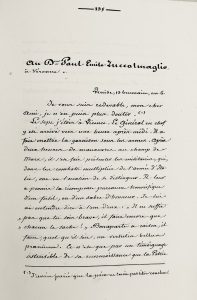
By 3 November 1797, Durand was stationed in Venice during the final moments of French occupation. He describes Bonaparte’s arrival in Vincenza near Venice:

“The General-in-Chief arrived yesterday at noon. He reviewed the troops on the Champ de Mars and presented soldiers distinguished in combat with rifles and sabers of honor… ‘It is not enough that you be brave,’ I heard him say, ‘everyone must know it!’”

This scene places Durand at the center of political and cultural events in Venice during the transition imposed by the Treaty of Campo Formio.

Durand transcribed an extraordinary passage from a speech delivered by Bonaparte in Vicenza during the spring of 1797, a moment when French authority had only just been imposed over the former Venetian territories. According to Durand, the General addressed the assembled troops with these words:
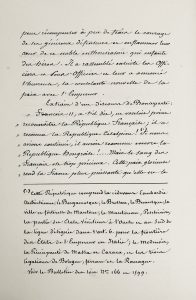

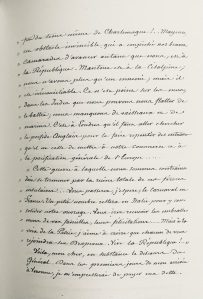
“Frenchmen! he said, you refused to recognize the French Republic; yet behold, it has recognized the Cisalpine Republic! And had we continued on this course, it would soon have recognized the Hungarian Republic as well. But the blood of Frenchmen is too precious. This glorious peace makes France more powerful than she was in the very time of Charlemagne. Mayence, that invincible obstacle which prevented our brave comrades from advancing as far as we have, now belongs to the Republic. Mantua belongs to the Cisalpine Republic; we have but one enemy left, and he is irreconcilable. It is not on the seas, nor in the Indies, that we may hope to defeat him; we lack ships and seamen. It is in London that we must go to seek out the perfidious Englishman, to make him repent of the obstacles he ceaselessly places in the way of our commerce and of the general pacification of Europe. This war, to which we are forced, must end with the total ruin of that ferocious islander. You will spend, I hope, the Carnival in France. A small number of you will remain in Italy to consolidate our work; for them, receive in advance the embraces of  your families and their congratulations. But at the call of the Fatherland, I like to believe that each of you will rejoin his flag. Long live the Republic!”

Durand concludes that this represents the substance of the discourse he heard in Vicenza—an account unique today, absent from official sources, yet entirely coherent with Bonaparte’s rhetoric and strategic aims in 1797.
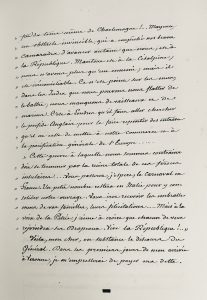

24 November 1797: Cultural Inventory of Verona

Durand’s letter from Brescia on 24 November 1797 is effectively a cultural inventory of Verona. He lists artworks by Titian, Veronese, Tintoretto, Guercino, and others; describes the Maffei Museum; the city’s social assemblies and theaters; and its intellectual lineage from Catullus to Fracastoro.

This letter stands as a rare snapshot of Verona at the precise moment French commissioners were evaluating and removing its treasures.

Durand’s Intellectual and Moral Position

Durand records events without explicit approval or condemnation. His tone is factual—suggesting confiscation had become normalized within military culture, even as he personally admired the art. His writings reveal the human dimension of cultural loss.

Historical Significance of the Letters

  • Names individuals involved in confiscations (e.g., Blésimare)
  • Describes seizure of scientific and natural history objects
  • Documents Verona’s cultural landscape before French removal
  • Contains details absent from official records
  • Reveals how cultural plunder was justified and executed

Extraordinary Discovery: The Official French Confiscation Inventory (Rome, 1796–1797)

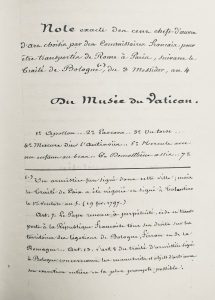
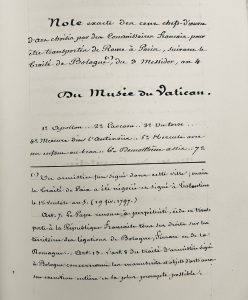
Durand’s manuscript contains a complete transcription of the official French government inventory of artworks and antiquities confiscated from Rome and the Vatican under the Armistice of Bologna (20 June 1796) and the Treaty of Tolentino (19 February 1797). This list would form the foundation of the Musée Napoléon (now the Louvre).

Complete list of confiscated Artworks

Conclusion

Durand’s letters and the unofficial inventory together form the most complete surviving picture of the French confiscation of Italian art during the campaign of 1796–1797. They trace a progression from expectation to participation to documentation, revealing both the machinery of occupation and the fragile cultural worlds caught within it.

Through these documents, Durand becomes an indispensable witness to one of the most significant episodes of cultural displacement in European history.

Volume two:

Unpublished manuscript of Adrien Durand, French prisoner of war in Hungary in 1793

Unpublished manuscript of Adrien Durand, French prisoner of war in Hungary in 1793
Volume 2

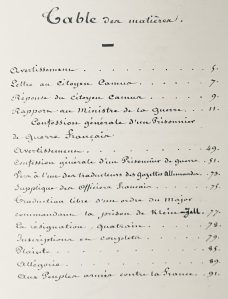
The manuscript presented here contains an account written by Jean-Baptiste Adrien Durand, born in Fécamp on 23 September 1767, described within the text as an officier d’infanterie and as a prisoner in Hungary in 1793. His account names several locations associated with the movement and confinement of French prisoners, including Linz, Vienne, Ebersdorf, Moson, Klein-Zell, and Pesth. Some passages state explicitly that they were written in Pesth.

The first chapter begins with his description of the early stages of imprisonment and the movements of French officers through Austrian and Hungarian territory. It is reproduced here as it appears in the transmitted manuscript.

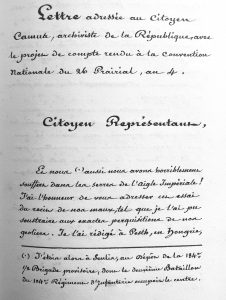
Letter addressed to Citizen Camut, archivist of the Republic, with the draft report to the National Convention of 14 June 1796.

Translation of the letter

“Citizen Representative,

We too have horribly suffered in the claws of the Imperial Eagle! I have the honor of addressing to you this essay, an account of our misfortunes such as I was able to save from the exact searches of our jailers. I wrote it at Pesth, in Hungary, where we were confined to the number of five hundred officers and some soldiers. My comrades provided me with notes. It is accurate. You will judge if it can be of some utility to sustain the ardor of the French to fight the Austrian, and especially if it can serve to disabuse the too great number of those who obstinately believe in sentiments of justice and humanity from this atrocious government.

The circumstances might require another form for this report; but the time taken by my duties and my little practice of writing do not permit me to give it to it. These are facts, moreover, that need to be made known. If you believe it should be used, you will kindly present them in the aspect that seems most suitable to you, sending me back the draft.

Footnote: “I was then at Senlis, at the Depot of the 184th provisional demi-brigade, of which the second Battalion of the 104th Infantry Regiment occupied the center.”

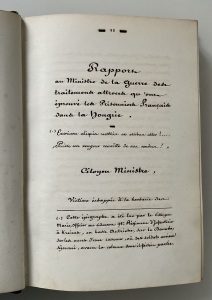
Translation of the first page of the report


Rapport au Ministre de la Guerre des traitements atroces qu’ont éprouvé les prisonniers français dans la Hongrie.

 (Report to the Minister of War on the Atrocious Treatment Suffered by French Prisoners in Hungary)

Exoriar aliquis nostris ex ossibus ultor!…
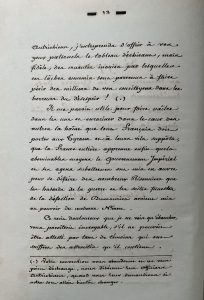
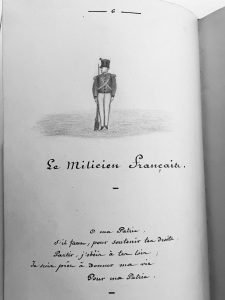
« Puisse un vengeur renaître de nos cendres ! »

(This epigraph was read by Citizen Marie, officer of the 98th Infantry Regiment, at Krems in Lower Austria, on the Danube, on the walls of a barracks where soldiers had stayed before the column of which he was part.)

“A victim who has escaped Austrian barbarity, I have undertaken to lay before your paternal eyes the dreadful yet faithful picture of the unheard-of cruelties by which our unfortunate countrymen were made to perish, in the midst of your fellow citizens, in the very depths of despair. (¹)

It may be useful to awaken within you an indignation that must equally stir the heart of every Frenchman when he learns of the vile purpose to which the Imperial government and its subordinate agents resorted by the most abominable means, in order to rid themselves of the numerous prisoners whom the hazards of war—after the disastrous defection of Dumouriez—had placed in the power of this modern Nero.

The sorrowful narrative I am about to begin would seem unbelievable were it not confirmed by so many witnesses who endured the very atrocities it contains.”

(¹) Our convention for exchanging prisoners having been abandoned, we asked the Austrian officers when our soldiers would be exchanged.

End of translation

Historic context

The defection of General Charles-François Dumouriez in April 1793 marked one of the most stunning reversals of the French Revolution. Only months earlier he had been celebrated as the victor of Valmy and Jemappes, the savior of the young Republic; yet, confronted with the radicalization of the Revolution and the execution of Louis XVI, Dumouriez broke with the Convention, attempted to march his army against Paris, and finally passed over to the Austrians. His betrayal shattered the fragile equilibrium of the Revolutionary Wars and cast immediate suspicion on every French soldier who fell into enemy hands.

The consequences for French prisoners of war were catastrophic. The agreements governing exchanges were abruptly abandoned. Austrian authorities, fearing further defections or subversion within their own ranks, adopted increasingly severe measures. Thousands of French soldiers captured on the Rhine, in Belgium, and along the Danube found themselves transported deep into the Habsburg territories—into Styria, Lower Austria, and the remote counties of Hungary—where they languished in barracks, fortresses, improvised depots, or forced-march columns that often resembled chains of convicts more than military captives. Many perished from hunger, disease, exposure, or direct brutality; others survived only to recount the horrors they had witnessed.
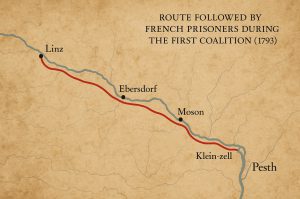
Map of the approximate route to Hungary described by Durand
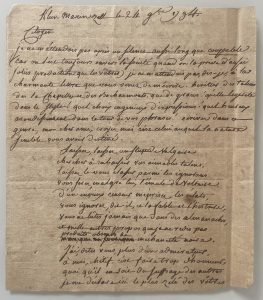
The manuscript presented here, addressed to the French Minister of War, is one such testimony. Written by a soldier who escaped what he calls “Austrian barbarity,” it is both a personal account and an act of moral accusation. Its author seeks not pity, but justice: a careful and faithful tableau of the treatment inflicted upon French prisoners in Hungary, offered to the “paternal eyes” of the Minister so that the truth might be known at last. The narrative that follows is at once sorrowful and indignant, its tone sharpened by the Latin epigraph—borrowed from Virgil—invoking an avenger rising from the ashes of the oppressed.

Without the corroborating testimony of numerous surviving prisoners, the events described might seem unbelievable. Yet they form part of a larger, now largely forgotten history: the suffering of thousands of Revolutionary-era captives whose fate was sealed not on the battlefield, but by political collapse and diplomatic rupture. This manuscript restores their voices and preserves the memory of what they endured.


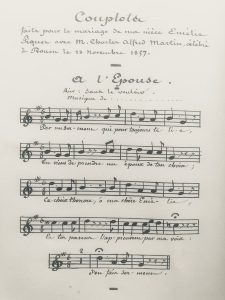
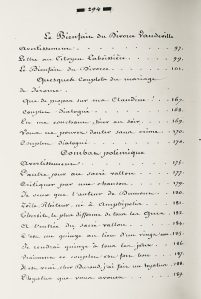
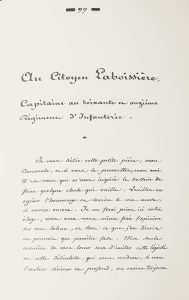
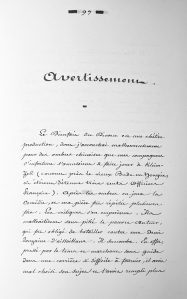
Following the prisoner writings, Durand inserted a substantial theatrical work that stands apart from the gravity of the first pages: a seventy-seven-page vaudeville titled “Le Bienfait du Divorce.” This play was written to amuse and distract his fellow prisoners, who were to perform or recite parts of it during their internment. It reflects a strikingly modern subject. Divorce, introduced by the French Revolution in 1792, was a new legal right and had not existed under the Ancien Régime. Durand’s decision to create a comic work based on this radical reform—at a time when he and his companions were confined in enemy territory—underscores the mixture of resilience, wit, and political awareness that characterizes his work. The play is preceded by an “Avertissement,” followed by a dedicatory letter to his friend and fellow officer Laboissière, and then unfolds in songs, couplets, dialogues, and light theatrical scenes intended for performance among the prisoners.

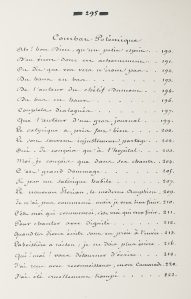
After the vaudeville, Durand continues the volume with a sequence of polemical verse grouped under the collective title Combat polémique. These short pieces include satirical poems, epigrams, responses to rival writers, defenses of friends, and commentary on contemporary political debates. Many are addressed to named individuals, offering insight into Durand’s circle and the literary culture of Revolutionary soldiers.
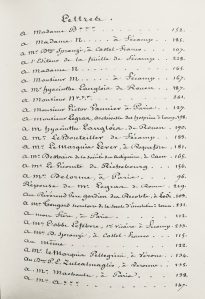
The manuscript continues with a transcription of letters to and from Durand. Several original letters received by Durand are preserved loosely within the manuscript but  also transcribed, with the replies into the text. Their presence confirms the copyist’s disciplined fidelity to the original materials used in assembling the volume.
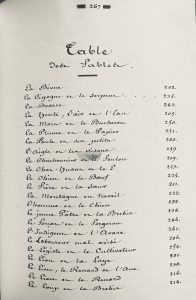
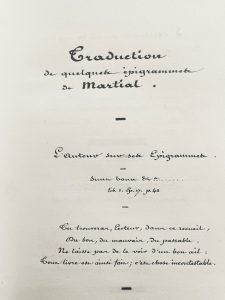
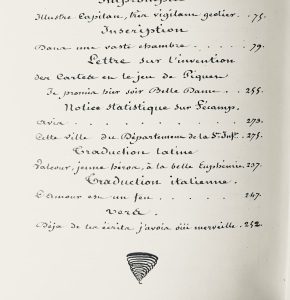
The manuscript concludes with translations from Latin and Italian, an essay on the invention of playing cards, a statistical notice on Fécamp, published in small edition in 1810, and a final group of verses, completing a manuscript marked by range and coherence.


Volume 5

Adrien Durand: Clarified Chronology of Captivity, Italian Journey, and Later Writings


Empire, Education, and Sacrifice: Charterhouse, the Duke of Devonshire Prize, and the Short Life of Denis Percival Beauchamp Taylor


1912 Duke of Devonshire Prize British Empire League Charterhouse Taylor Sea Power Mahan RFC MC KIA

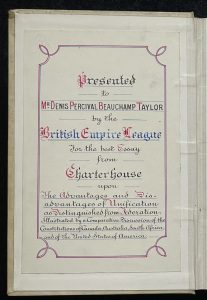
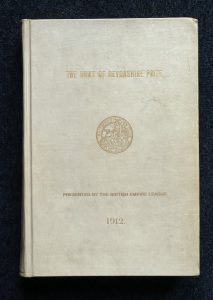
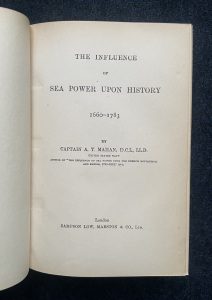
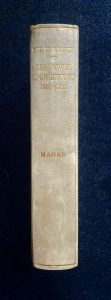
Bound in full vellum-grained white presentation cloth, gilt stamped with the seal of the British Empire League and titled “The Duke of Devonshire Prize—Presented by the British Empire League—1912,” all edges gilt. A 1912 Charterhouse School prize copy awarded to Denis Percival Beauchamp Taylor, later Lieutenant 3rd Hussars and Royal Flying Corps, recipient of the Military Cross and killed in action 14 March 1916 at the age of 21 years old (old a cruel misnomer for someone who died so young). Includes the original illuminated manuscript prize leaf presenting this volume to Taylor for the British Empire League essay competition. London: Sampson Low, Marston & Co., early twentieth-century impression using the 1890 plates of A. T. Mahan’s The Influence of Sea Power upon History, 1660–1783. A rare imperial prize binding linking Charterhouse pedagogy, the Duke of Devonshire’s educational patronage, and the early military career of an M.C.-winning officer lost in the Great War.

Empire, Education, and Sacrifice: Charterhouse, the Duke of Devonshire Prize, and the Short Life of Denis Percival Beauchamp Taylor

In the early twentieth century, Charterhouse School stood as one of the leading English public schools shaping the intellectual and moral formation of Britain’s imperial elite. Founded in the seventeenth century and firmly established among the great schools by the Victorian era, Charterhouse cultivated a culture of disciplined scholarship, athletic rigor, and patriotic service. Its curriculum and civic ethos were deliberately aligned with the larger ambitions of the British Empire, preparing young men not merely for university but for leadership positions in the Army, Navy, civil service, and colonial administration.

Within this educational environment, academic essay prizes carried exceptional weight. Among the most prestigious was the Duke of Devonshire Prize, awarded under the auspices of the British Empire League. The League, founded in 1895, promoted imperial cohesion and saw education as a principal instrument for instilling loyalty, civic awareness, and a broader understanding of the constitutional and geopolitical structure of the Empire. Through school competitions, it encouraged students to interrogate the political frameworks that connected Britain with its dominions and to develop the analytical skills expected of future statesmen and officers.

The 1912 competition at Charterhouse exemplified this program. The assigned topic—examining the advantages and disadvantages of unification versus federation, illustrated through the constitutions of Canada, Australia, and the United States—reflected contemporary debates regarding the political destiny of the British world. The question required not only historical knowledge, but substantial comparative insight into governance, sovereignty, and the evolving relationship between Britain and its dominions. The winner of this demanding exercise was Denis Percival Beauchamp Taylor, a young man whose brief life illustrates the ideals and tragedies of his generation.

Taylor, born in 1894 and associated with Toft Manor in Cambridgeshire, entered Charterhouse in 1908. His scholarly promise quickly became evident, culminating in his receipt of the 1912 Duke of Devonshire Prize. The volume awarded to him—A. T. Mahan’s The Influence of Sea Power upon History, 1660–1783, specially bound in a gilt-stamped British Empire League presentation binding—serves as a fitting symbol of the intellectual and imperial values celebrated by the prize. Mahan’s work, which reshaped naval doctrine across the world, was profoundly influential in British strategic thought. Its selection as a prize book underscored the League’s commitment to shaping young minds for imperial citizenship and military responsibility.

Following Charterhouse, Taylor continued along the traditional path of the Edwardian public school officer, entering the Royal Military College, Sandhurst. Commissioned into the 3rd (King’s Own) Hussars, he soon found himself thrust into the demands of the First World War. Like many young officers of his background, he transferred to the Royal Flying Corps, the new and perilous arm of service that attracted volunteers from Britain’s most academically and socially elite institutions. Taylor distinguished himself in action and was awarded the Military Cross, a decoration for gallantry.

His life ended abruptly on 14 March 1916, when he was killed in action on the Western Front at just twenty-one years of age. Charterhouse recorded his name on its Roll of Honour, and he is likewise commemorated in the records of the 3rd Hussars, the Royal Flying Corps, and his home parish in Cambridgeshire. His prize book, preserved with its illuminated manuscript presentation leaf, now serves as a rare and poignant artifact linking his intellectual promise, his imperial education, and his wartime sacrifice.

Viewed through this single surviving volume, the world of early twentieth-century British imperial education comes clearly into focus. The book embodies a complete narrative: the values of Charterhouse; the ideological mission of the British Empire League; the intellectual formation of a young scholar; the military trajectory of a decorated officer; and the profound losses inflicted by the Great War. As both a prize of scholastic distinction and a relic of personal history, Taylor’s copy of Mahan stands as a testament to a vanished era, preserving the intertwined stories of school, empire, and sacrifice.

1759 Manuscript ledger of Gaud estate seizure and sale, Russey, Bailliage d’Ornans, 43,000 livres

Quarto manuscript ledger, 116 leaves, contemporary limp wrappers with docket title, recording the judicial seizure, inventory, auction, and distribution of the extensive properties of Claude Gaud and Claude Joseph Gaud, merchants of Russey (Doubs), under the Bailliage Royal d’Ornans. Detailed descriptions of houses, barns, presses, gardens, vineyards, meadows, and woodlots, each valued and sold at public auction to nobles, clergy, and merchants including Léonard Blanchard (vicar of Russey), Pierre François Calamand, the Accarin brothers of Besançon, the abbé de Nozeroy, and the Duke and Duchess of Randan, whose seigneurial dues were confirmed in priority. Total realized over 43,000 livres; proceeds distributed to creditors in strict rank. Signed at close by Simon François Xavier Simonin de Deservilliers, lieutenant général, and Jean Antoine Tournier, greffier. An extraordinary survival of rural debt liquidation and feudal law in 18th-century Franche-Comté.