Military exploits of Prince Maurice of Nassau, 1st ed. in French; Fairfax/Osterley Park copy, with notes attrib. to Sir Walter Raleigh.


This volume represents a significant bibliographical and historical artifact: the 1612 first French edition of Jan Jansz Orlers’ survey of Prince Maurice of Nassau’s military campaigns, with extensive engraved plates and maps. The Fairfax/Osterley Park copy holds substantial historical weight, marked by manuscript annotations tentatively attributed to Sir Walter Raleigh. The association stems from five distinctive first-person annotations recorded in ink, and referenced – albeit imperfectly – by bibliographer William Oldys in his 1736 biography of Raleigh.


The claim of Raleigh’s ownership arises from these marginal notes, the tone of which suggests personal commentary. Raleigh’s well-documented inconsistencies in handwriting complicate definitive attribution, yet this volume likely embodies his marginal engagement with narratives of European naval conflicts—a subject of personal and professional importance to him. Interestingly, Oldys transcribed these notes into corrected French, potentially diluting their evidentiary strength.


Adding complexity, Oldys referenced a parallel, now-lost “pencil-annotated copy” purportedly held by Thomas Brian Esq. (see addendum below) of the Inner Temple. No concrete evidence of this phantom copy exists, nor do bibliographical records substantiate Oldys’ claim beyond his biography. Notably, Oldys himself was notorious for erratic behavior and dubious scholarly methods in his later years, as he spent time in Fleet prison for debt and was described as “rarely sober in the afternoon.”


Thus, this Fairfax/Osterley Park copy, with its ink marginalia, remains the most credible candidate for direct Raleigh provenance.

Bibliographical Note:
This edition is the first French translation of Orlers’ 1610 *Den Nassauscgen Lauren-crans*, detailing Maurice of Nassau’s campaigns during the Dutch Revolt. The 43 engraved plates include a significant depiction of the Armada battle (folio 36), noted by Kraus as “one of the very rare contemporary representations of the Armada battle” (Sir Francis Drake: A Pictorial Biography, p.35).

Early Provenance:
Annotations:

  • Folio 137: “mais bien arriere”
  • Folio 138: “a moy seule”; “Jeay prix tous deux”
  • Folio 139: “en lequelle ils m’ont trompe”; “Par la refuse nous avons *2 millions* perdu”
  • Folio 136: Correction of ship numbers from printed 57 to penned 67 (not mentioned by Oldys).

All annotations appear in the same hand, likely contemporaneous, adding credibility to Raleigh’s potential ownership.

Provenance Trail:

  • Sir Walter Raleigh? (1552–1618)
  • Bryan Fairfax (d. 1749) & Robert Fairfax, 7th Lord Fairfax of Cameron
  • Sold via Prestage (1756) – lot 945, entire library pre-sold
  • Francis Child (d. 1763), Osterley Park Library (shelf mark X.1.3.9)
  • Victor Child Villiers, 7th Earl of Jersey (Osterley Park sale, Sotheby’s, 1885, lot 1187)
  • Bernard Quaritch (1885)
  • Mary Olivia Nutting (1894), referenced in *The Days of Prince Maurice*
  • George Hale Nutting; Andrew Stewart (bookplate)

Critical Reflection:
It is plausible that Oldys used this ink-annotated copy as the source for his pencil-copy claim, or was himself referencing derivative annotations. Oldys’ own scholarly unreliability casts doubt on the existence of a separate marginalia copy.

Thus, the Fairfax/Osterley Park volume stands as the most reliable artifact linking this work to Raleigh’s personal library.

References:

  • Raleigh, W. (1829). The Works of Sir Walter Raleigh, Now First Collected. Oxford University Press. Vol. I, p.245.
  • Oldys, W. (1736). Biography prefixed to The History of the World by Sir Walter Ralegh, Kt. London: William Jaggard.
  • Oakeshott, W. (1968). “Sir Walter Ralegh’s Library.” The Library, 5th Ser. 23, pp. 285–327.
  • Prestage. (1756). A Catalogue of the Library of Bryan Fairfax. London. Lot 945.
  • Morell, T. (1771). Catalogus Librorum in Bibliotheca Osterleiensi.
  • Sotheby’s (1885). The Osterley Park Library. Catalogue. Lot 1187.
  • Quaritch, B. (1885). Rough List, No. 71.
  • Nutting, M. O. (1894). The Days of Prince Maurice. Boston & Chicago.
  • Kraus, H. P. (1970). Sir Francis Drake: A Pictorial Biography. p.35.

Compare Marginalia:


Marginalia folio 139


Marginalia folio 138


Marginalia folio 137


Marginalia folio 136

Addendum:

We found no verified biographical records or substantial archival references for a Thomas Brian Esq. of the Inner Temple, specifically as mentioned by William Oldys regarding the “pencil-annotated” Raleigh volume.

Critical Insight:

  • Oldys references “Thomas Brian Esq. of the Inner Temple” in his 1736 biography of Raleigh, noting the ownership of a volume annotated in pencil.

  • No known Inner Temple membership records, probate inventories, or bibliophilic collections substantiate a bibliophile or collector by that exact name and title.

  • It is possible that:

    • Oldys confused the surname (possibly meaning Bryan/Bryan rather than Brian).

    • The reference was fabricated or based on erroneous second-hand information.

Historical Implication:

Given Oldys’ known lapses in scholarly rigor (including inebriation and inconsistent record-keeping), his attribution of the “pencil-noted” volume to this individual should be approached skeptically. The absence of corroborating documentation for “Thomas Brian Esq.” strengthens the argument that the Fairfax/Osterley Park copy is the most likely source of the annotations Oldys described.

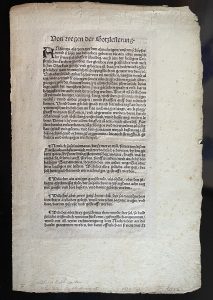
Circa 1520 placard, Von wegen der Gotzlesterung or Concerning Blasphemy

Concerning Blasphemy.  (Hagenau, Th[omas] Anshelm 1520).
Separate printing of Ferdinand’s ordinance, issued as imperial governor in Württemberg during the exile of Duke Ulrich.

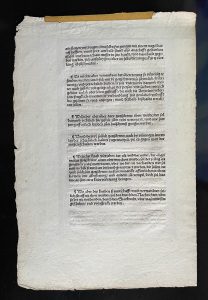
A two page placard spelling the punishments for blasphemy, For adults and children.

“Whoever swears by God three times, shall, as soon as this becomes known, be immediately arrested, and without any further justification be handed over to the executioner, who shall then publicly at the free market nail his tongue and pierce it with a nail, and while he is thus fastened, give him a knife in his hand, and the choice to tear himself free, or to cut off his tongue, short or long.”

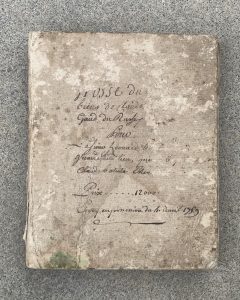
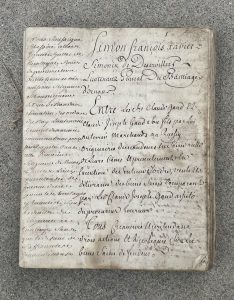
Chrétienne d’Aguerre Comtesse de Sault financial records

SOLD

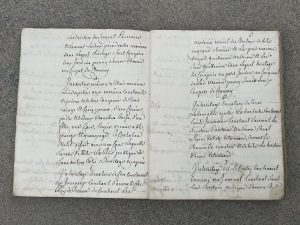
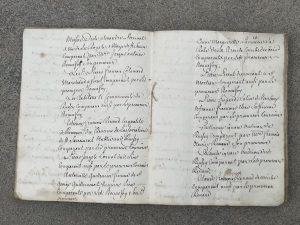
An accounting book of significant historical importance

Chrétienne d’Aguerre (1553-1611), comtesse de Sault, fut une figure influente durant les guerres de Religion en France. Originaire de Lorraine, elle épousa en premières noces Antoine de Blanchefort, avec qui elle eut un fils, Charles. Veuve, elle se remaria en 1578 avec François-Louis de Montauban d’Agoult, comte de Sault, et s’installa en Provence. Après la mort de son second époux en 1586, elle devint tutrice de ses enfants et s’engagea activement dans la Ligue catholique, dirigeant la Ligue aixoise et s’alliant avec le duc de Savoie pour contrer les protestants. Son influence politique et ses actions militaires marquèrent l’histoire provençale de cette époque. ​


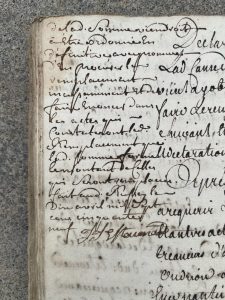
The first entry is for the Comte de Sault, dated May first 1584, mentioning a sum of 5400 florins to be arranged over a period of four years.

On page 105, is an entry for Madame la Comtesse de Sault, dated April 25, 1588, allocating the sum of 6060 florins to be arranged also within a four years period.


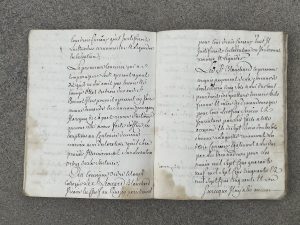
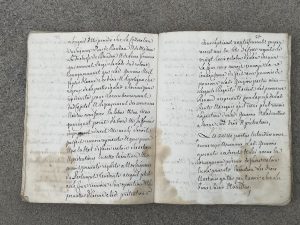
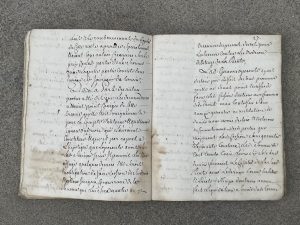
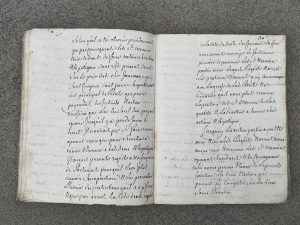
There are 127 leaves in the manuscript, written on both sides

Chrétienne d’Aguerre, comtesse de Sault (1553–1611), played a pivotal role in the French Wars of Religion, particularly in Provence between 1584 and 1590. Born to Claude d’Aguerre and Jeanne de Hangest-Moyencourt, Chrétienne was deeply embedded in the Catholic nobility. Her first marriage to Antoine de Blanchefort produced a son, Charles de Blanchefort-Créquy. Following Antoine’s death, she married François-Louis de Montauban d’Agoult, comte de Sault, in 1578, with whom she had several children, including Jeanne and Louis.  

After François-Louis’s death in 1586, Chrétienne assumed control of the family’s estates and became a staunch leader of the Catholic League in Provence. Residing in Aix-en-Provence, she orchestrated military and political strategies against Protestant forces. Her influence was so profound that she convinced local leaders to appoint Charles-Emmanuel I, Duke of Savoy, as governor of Provence. However, disagreements led to her imprisonment by the Duke; she later escaped, reportedly disguised as a gardener.  

Chrétienne’s leadership during this tumultuous period underscores the significant roles women could play in early modern European politics, especially within the context of religious conflicts.