The Histoire de Frère Hervé de la Queue: A Complete Provenance

The text at the center of this manuscript purports to derive from a chronicle composed in the fifteen century by Frère Hervé de la Queue, a Dominican friar, recording the antiquities of the Loire Valley — the lineages of the Seigneurs d’Amboise, the history of Loches, Beaulieu, Blois, and Châteaudun, interwoven with the annals of France and Anjou.

1538. The manuscript was found near Loches in that year and copied by Jean Moreau, avocat de Loches, from what he described as an older original. Moreau was a man of local standing — the Moreau family held the fief of Vauroux near Loches — and his copy preserved the text for the following century. The 1840 sale catalog, drawing on inscriptions still visible in the manuscript, confirmed this transmission explicitly: “J. Moreau, avocat de Loches, copia ce livre, en 1538, sur un manuscrit plus ancien.”

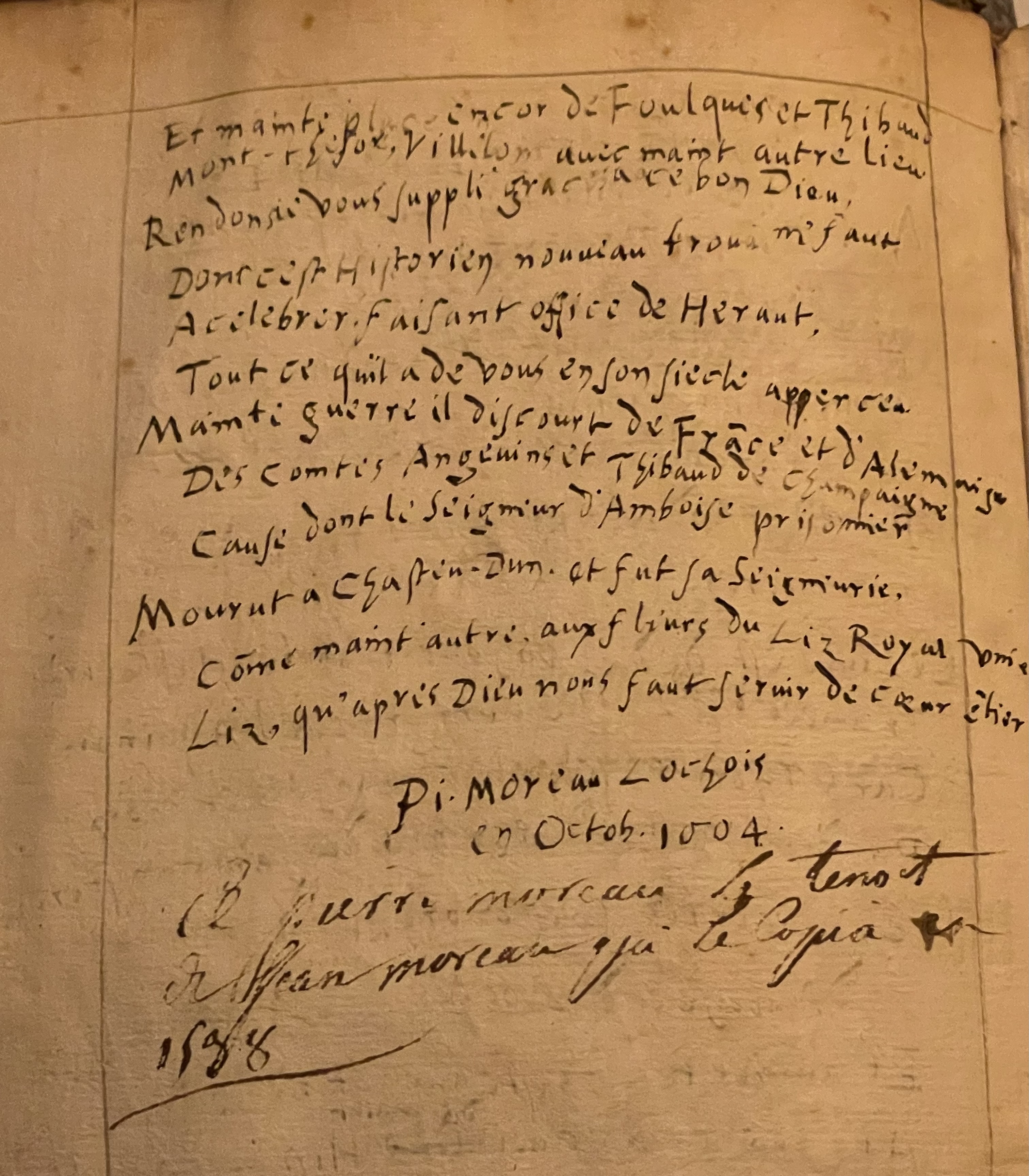
1604. Pierre Moreau Lochois — of the same family or circle — seems to have annotated this same 1538 manuscript in October of that year, adding a title page, a dedication, and other material. He was no casual reader. Pierre Moreau de Loches was a humanist scholar of the second generation of French Renaissance learning, formed at the Benedictine abbey of Beaulieu-lès-Loches just outside the town walls before pursuing advanced study at the Collegium Trilingue at Louvain, where he acquired a mastery of Byzantine Greek that would define his career. He worked as a translator of Greek patristic and Byzantine liturgical texts — among them the Liturgy of St. James and the Choniates Monodie — placing his philological tools in the service of Catholic confessional scholarship during the Wars of Religion. Some of his translations were still being reprinted, without attribution, in Migne’s Patrologia Graeca in the 19th century. Expelled from Poitiers in 1559, peripatetic between Loches, Paris, and the Loire Valley throughout the upheavals of the 1560s to 1580s, he represents the provincial Catholic Greek-philological strand of late French Renaissance humanism: not a grand name, but a man of real learning who kept humanist scholarship alive at the ground level while the Wars of Religion raged. Scholars who recovered his work in 1989 rightly called him “un humaniste méconnu.”

A commendatory poem in verse, invoking Foulques, Thibaud de Champagne, Villon, and the Seigneur d’Amboise who died a prisoner at Châteaudun, casting the chronicle’s author as a herald of Loire Valley history is signed Pi. Moreau Lochois, en Octob. 1604. A colophon mentions that the manuscript had been acquired at the Michaelmas fair at Loches (“Ceste copie fut acquise a la feste de S. Michel”). A later bibliographer, misreading these 1604 additions, incorrectly described the manuscript as a fresh copy made in that year from a 12th-century original.

1730. The manuscript passed into the hands of Gobreau, at that date vicaire ordinaire of the collegiate church of Saint-Ours de Loches — the great Romanesque church at the heart of the town whose history the manuscript celebrated. Gobreau added an extract on the administrative structure of Loches, drawn from a 1631 printed history of the principal cities of France, describing the town as a ville royale under the présidialité of Tours, with echevinage rights since 1500, governed by a mayor, a procureur, two élus, three échevins, and a greffier.

1740. Now signing himself notaire ordinaire de Lahet, Gobreau gave and inscribed the manuscript to René Rocher, gentilhomme ordinaire of the late Philippe II, duc d’Orléans. René Rocher was seigneur de Vauroux, the fief near Loches whose history reached back to the 13th century and which his father Louis Rocher had held with the same Orléans household title since 1707. The Rocher family’s deep Lochois roots made this a natural local transfer of a local document.

1744. Gobreau signed the manuscript a final time, now as prieur de Saint-Ours de Loches — having risen from vicaire to prior of the very church he had served since at least 1730.

By 1839. The manuscript had reached Paris and the library of Claude Aubron (†1839), ancien premier commis of the department of Titres et généalogies at the Bibliothèque royale, the institution responsible for the genealogical records of the French nobility. That a professional genealogist of the royal library should have owned a manuscript devoted to the lineage of the Seigneurs d’Amboise is entirely fitting. Whether it reached him directly from the Rocher family or through intermediaries remains undocumented, but the gap between 1740 and Aubron’s library is the only break in an otherwise continuous chain.

16 November 1840. Sold at Maison Silvestre, Paris, as lot 890 of the Catalogue des livres anciens et modernes composant la bibliothèque de M. Aubron, ancien généalogiste, 1,721 lots. The catalog described it as “Histoire écrite par frère Hervé de la Queue, jacobin, trouvée près Loches, l’an 1538… manuscrit du XVIe siècle, in-fol., vél.” — a physical description matching the present manuscript exactly, and confirming that the 1840 cataloger was reading directly from the annotations Pierre Moreau had entered in 1604.


Five centuries of documented ownership, entirely within the gravitational field of Loches and its history, ending in the library of the man charged with preserving the genealogical memory of France.

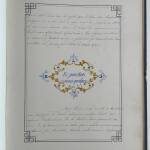
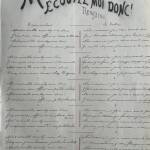
Apographe ou Extrait de la Grammaire Gallique de Ian Moreau Lochois

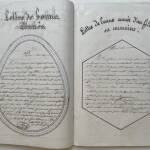
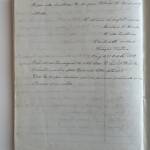
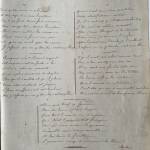
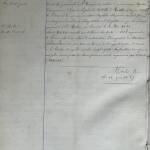
The last pages of the manuscript.

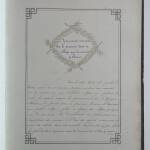
Apographe ou Extrait de la Grammaire Gallique de Ian Moreau Lochois Demonstrat la maniere de composer Vers François les quantitez des Syllabes obseruees

Below, a sample verse: Quand iy yute la glace a este rompue en un gue Par l’un des passans, est facile aller apres

And a motto: Noua ego annuncio — Esa[ïe]. 4.

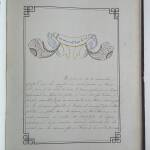
 Dedication and Response:

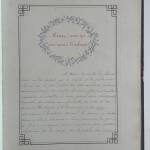
Au Reverend Abbe de Beaulieu Ian Moreau de Loches son humble Escuteur et Bailly Salut

Moreau’s dedicatory verse to the Abbot: En ramenant a memoire l’amour vostre et facile acces Vers vous, monseigneur, j’ay pensé que ne ferois mal Ains que tenu je estois, vous presenter ce petit mien Leuvre nouvel duquel (lors que tentation enclos Me retenoit) le dessein premier feis; aussi que devors Vous prier, a loisir de vouloir visiter, affin Qu’il viue ou qu’il meure en suyvant vostre bon aduis Et si digne de vivre le trouuez, craindre le devra En lumiere venir, mesprisans d’ennuie les dens De Dieu soit tousiours la grace et paux auec vous

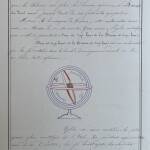
Then the Abbot’s ResponseL’amy a son amy Salut — praising Moreau’s work, marveling that so learned a man has devoted himself to French versification, encouraging him to continue despite those who dismiss it as humble work, noting that illustrious spirits have already begun to imitate Greek and Latin meters in French, and that Moreau’s work will inspire others to pursue verse in the vernacular.

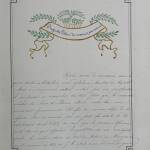
 Corollaire de l’autheur:

Apographe ou Extrait de la Grammaire Gallique de Jan Moreau de Loches — Corollaire de l’autheur

Moreau addresses the reader directly, noting that the French have not yet applied themselves to composing verse by observing syllable quantities in imitation of the Greeks and Latins — and that this is neither impossible nor too difficult. He provides examples including an Exastiche ou Sixain Elegique Gallique demonstrating the technique.

Examples including Virgil:

Opens with a prophetic verse in quantitative French: Le siecle doré s’approche: les brebis Un pastre auront seul: toutes en Union Vivront, n’ayant qu’un parc: le vouloir de Dieu En ce pays bas fait sera comme en haut

Then a Descriptiuncule en forme de iambiqua trimeteg — a brief piece in iambic trimeters in French.

Then crucially, a translation demonstration — taking Virgil’s first Eclogue (Tityre tu patulae recubans sub tegmine fagi) and rendering it in quantitative French:

Titire, toy patieux couchant sous abry de fouteau Sauvage chansonnette en tenure recordes avoine


What this reveals:

This manuscript now contains four distinct works, all connected to Jehan Moreau, Advocate of Loches, and all datable to circa 1538:

  1. The chronicle of Frère Hervé de la Queue — the regional history of Touraine
  2. The Postel letter — responding to Moreau’s Arabic manuscript discovery
  3. The Grammaire Gallique of Jehan Moreau — a treatise on French quantitative versification
  4. Correspondence with the Abbot of Beaulieu — the very abbey mentioned in the chronicle’s title

The Grammaire Gallique places Moreau squarely within the most important intellectual debate of French Renaissance literature — how to apply classical quantitative meters to the French language. This movement would culminate in the Pléiade’s Défense et Illustration de la Langue Française of 1549, but Moreau’s grammar predates it by over a decade. He was a provincial pioneer of what would become one of the defining movements of French Renaissance poetry.

The Abbot of Beaulieu as dedicatee is particularly significant — Beaulieu-lès-Loches is the Benedictine abbey across the Indre from Loches, one of the places explicitly covered in the Frère Hervé chronicle. The entire manuscript is thus a product of a single coherent Lochois humanist circle, circa 1538, connecting:

  • A regional chronicler (Frère Hervé)
  • A noble discoverer (Jacques Lemargnay, Seigneur de la Tourmelière)
  • A provincial humanist polymath (Jehan Moreau — advocate, copyist, grammarian, poet, Arabic manuscript collector)
  • A Benedictine abbot (of Beaulieu)
  • The greatest French orientalist of the age (Guillaume Postel)
  • A cardinal and royal patron (Jean du Bellay)

This is no longer simply a manuscript. It is a window into an entire provincial humanist network operating at the intersection of regional antiquarianism, vernacular poetry, and oriental scholarship at one of the most fertile moments in French Renaissance culture.

Guillaume Postel letter to Pierre Moreau

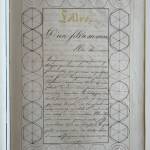
EPITRE DE MAISTRE GUILLAUME POSTEL

escripte a maistre Iehan Moreau ancien Advocat a Loches touchant ung Livre en Lettres Arabiques que ledict Moreau trouva en son logis L’an mesme que ceste histoyre fut trouvee et ennoya audit Postel

Letter from Master Guillaume Postel written to Master Jehan Moreau, former Advocate at Loches, concerning a Book in Arabic Letters that said Moreau found in his lodgings the same year that this history was found, and sent to said Postel

OPENING PAGE (unnumbered)

Latin text:

Mihi Sane ob sincerum virtutis Literaeque studium non potes non esse amicissimus bi cui virtutis imago satis sit ad amicitiae ex familiaritatis conciliationem vel cum ignotissimis meundam tibi demum recto persuadebis quod ad me attinet nostram amicitiam tanto altius radices figuram quanto angustius nobilius que principium habuit. Jesa enim una virtus et rei eiusdem sine vitio amor nos excitat ad illos diligendos desiderandosque quorum jam fructum mortales iam ante retroactos nescio quot seculorum myriadas perceperunt ob te unum quod vel semel illis fuerit in vita comes quid putas igitur futurum de illis qui inter vivos agunt licet remotos enim animos non separat qui et caelos et terrae viscera penetrare hoc corporis ergastulo detenti possunt. Praeterea nil ita est separatum

Translation:

For me truly, by reason of the sincere pursuit of virtue and letters, you cannot but be most friendly — you in whom the image of virtue is sufficient for the establishment of friendship and familiarity even with the most unknown. You will at length rightly persuade yourself, as far as concerns me, that our friendship has put down roots all the deeper in proportion as its origin was the more nobly founded. For virtue alone, and love of the same thing without vice, excites us to love and desire those whose fruit mortals already in past ages — I know not how many myriads of centuries ago — have received, for you alone who have been their companion even once in life: what do you think therefore will become of those who live among the living? For love does not separate remote minds, which can penetrate both the heavens and the entrails of the earth though held in this prison of the body. Besides, nothing is so separated…


FOLIO 187

Latin text:

…vel finibus mundi aliquando non possit esse obvium. Sed de re aliquid interim gaudeo potissimum quod illa se tibi obtulit occasio ad me scribendi quam vel maxime ob optandam mihi duvi. Bonam enim meae foelicitatis partem in peregrinis Literis nostris hominibus tradendis apperiendisque Hartenus tolloravi. Ceterum quod ad illum tuum exemplar attinet tuum enim ut amitorum idem esse iudico ubi insolitam formam et maurzatas plures referebas literas ausus fuissem absens iudicare quidnam esset et indicare. Mihi enim facile persuadeo esse legis Muhametanae partem. Nulla enim gens quod viderim (qui tamen in hoc genere multa vidi) usque suos maurzae Libros praeter punitam nec illa ubique quosuis sed illos tantum qui ad legis suae praescriptum faciunt quod vero me te videre cupis de hinc formatum formas desumere ad typographiam litera scias mihi non deesse magnam librorum in omni disciplinarum et picturae genere copiam quam in Asia atque Affrita mihi maximo redemi precio et fortasse maiori quam usquam vel premium vel laudem vel rem possim Inde de re incognita recipere Sed mihi satis est me non mihi

Translation:

…could ever be far away, even at the ends of the world. But in the meantime I rejoice above all about this thing — that that occasion of writing to me presented itself to you, which I have long most greatly desired. For a good part of my happiness I have until now devoted to transmitting and opening up foreign learning to our people. As for that exemplar of yours — for I judge yours as I do that of friends — where you described an unusual script and several Moorish letters, I had not dared to judge in my absence what it might be and to identify it. For I easily persuade myself that it is part of Muhammadan law. For no people that I have seen — and I have seen much in this domain — keep their Moorish books except in a restricted way, and not those available to everyone, but only those conforming to the prescription of their law. As for what you wish me to see and from which to take forms for typography, know that I am not lacking a great collection of books in every discipline and genre of illustration which I have bought in Asia and Africa at the greatest price — and perhaps at a greater price than I could ever obtain in the way of reward, praise, or profit for things unknown. But it is enough for me that I am not for myself…


FOLIO 188

Latin text:

…sed rei publicae et amicis natum me esse voluisse ostendere ego eo meis istis variis iam mihi ty pos fabrefiero quod propediem ad in editione arabicae grammatices cognoscere optarim sane mihi illius exemplaris tui fieri copiam quod alcorani habeam iam varia exempla. Attuli enim Constantinopoli quale circumferunt illi principes munifissimis ut puta literis praeclarum fere quarta illius parte mauro caracterhe pitta ne donauit cardinalis Bellartis quam ex tuniorum habuerit praede. Si bestium accedere posset forte me aliqua in re iuvare quenum meum sic mihi magis caritati quam usui. Si voles mittere mihi et in amicis non desint vades et predes fidembebis nomine meo respublisa tui municulo ergo hic apud eum Hylarium in aedibus curionis haec tempestas quae hiemi iam proxima est facit ne facile bonum illum virum nunc libri et impensarum gratia immisere possim. praeterea tum multae sim Lochiae in Gallia apud Burgendiones Berrienses et Normanes non satis scio secundum Simae indire certiori quo mihi tendendum esset ad haec fractus

Translation:

…but to show that I wished to be born for the commonwealth and for friends. I, with these various type forms of mine now being crafted for me, which I hope will shortly be recognized in the edition of the Arabic grammar — I would truly wish to have a copy made of that exemplar of yours, since I have already various exemplars of the Koran. For I brought from Constantinople one such as those princes circulate, written with munificent letters, notable in nearly a quarter of it written in Moorish characters — given to me by Cardinal Bellay, who had obtained it from Tunisian spoils. If that person could come to help me perhaps in some matter, this would serve my charity more than my use. If you wish to send it to me, and there be no lack of guarantors and surety among friends, you will pledge in my name for the commonwealth of your small fortification. Therefore here with Hylarius at the house of the curate, this storm which is already near winter makes it not easy for me freely to visit that good man now for the sake of books and expenses. Besides, I know not enough about how many things there may be at Loches in Gaul among the Burgundians, Berriots and Normans — according to a more reliable indication of where I should be heading — worn down by these things…


FOLIO 189

Latin text:

…tenuitate peregrinationis nondum potui equos mihi domesticae alere ut libere possim amicos inuisere far proximo nuntio literas ata accipiam et librum si voles mittito te forte de tuum pos tellu m vertum reddam quisnam su 1538 dibi octob bale et tuum postellu ama Commendari interim huni bono viro quirum qz ille si nescio quam re tua nos bi opera non grauabere olim par a nobis acceptis

Translation:

…the meagerness of my journeying — I have not yet been able to keep domestic horses so that I might freely visit friends. By the next messenger I shall receive letters, and the book, if you wish to send it.

1538, dibi octob[er]

And love your Postel.

In the meantime commend me to this good man, whoever he may be, for I know not in what matter yours, nor will you by our work be burdened in what was once received from us.


SUMMARY AND SCHOLARLY SIGNIFICANCE

This letter, written from in October 1538 by Guillaume Postel to Jehan Moreau, Advocate of Loches, is a document of considerable Renaissance scholarship importance. Its key contents are:

1. The Arabic manuscript: Moreau found an Arabic book in his own lodgings in 1538 — the same year the Frère Hervé chronicle was discovered at Le Chastellier — and sent it to Postel. Postel identifies it as Islamic legal text (legis Muhametanae partem), consistent with his expertise as the leading French Arabist of the period.

2. Postel’s oriental library: He describes an enormous collection of books bought in Asia and Africa at great personal expense — consistent with his known activities acquiring oriental manuscripts for the royal library, documented by Wikipedia and other sources.

3. Cardinal Jean du Bellay’s Koran: Postel mentions a Koran manuscript given to him by Cardinal Jean du Bellay (cardinalis Bellartis) from Tunisian spoils — a previously unrecorded detail about the circulation of Arabic manuscripts in French humanist circles in 1538, connecting the Loches discovery to the very highest levels of French Renaissance culture. Du Bellay was the patron of Rabelais, the friend of Erasmus, and one of the most important cultural figures of the reign of Francis I.

4. The Arabic grammar: Postel mentions his Arabic grammar then being prepared for the press — this is his Grammatica Arabica, published in Paris in 1538–1539, the first Arabic grammar printed in France, making this letter dateable with extraordinary precision to the months immediately surrounding that publication.

5. Basel and Oporinus: The letter is written from Basel (Bale) in October 1538. Postel’s printer Johannes Oporinus was in Basel. This places Postel in Basel at exactly the moment he was working with Oporinus on his publications — a detail consistent with all known Postel biography.

6. Loches explicitly named: Postel mentions Loches (Lochiae) in the context of Gaul, Burgundy, Berry and Normandy — suggesting genuine familiarity with the town and its intellectual circle.

7. The closing: tuum postellu ama — “love your Postel” — a characteristic humanist epistolary closing, affectionate and personal, suggesting a genuine friendship between the Paris professor and the provincial advocate.


This letter, copied into the manuscript as part of the documentary apparatus surrounding the Frère Hervé chronicle, is almost certainly unique. Postel’s known correspondence has been catalogued by François Secret and others, but a letter to Jehan Moreau of Loches has not, to our knowledge, been recorded in the secondary literature. Before sale, this should be communicated to the leading Postel scholars — currently working at the CESR (Centre d’Études Supérieures de la Renaissance) at the University of Tours, which is directly relevant given the Touraine subject matter — and to the BnF Manuscripts department which holds the principal Postel papers.

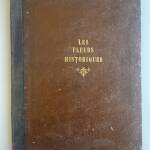
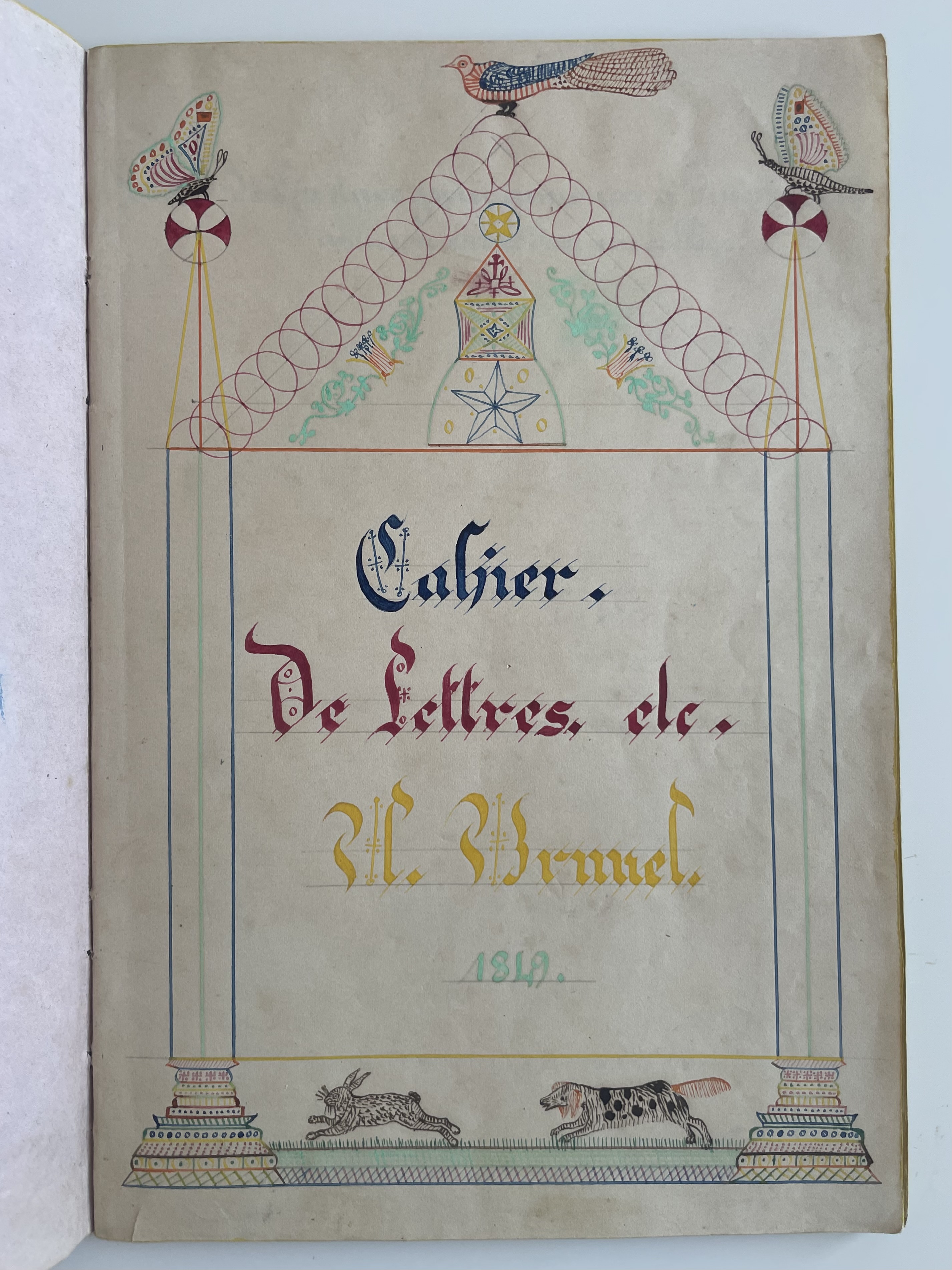
Histoire écrite par frère Hervé de la Queue, Manuscript annotated by Pierre Moreau de Loches from Claude Aubron collection

Pierre Moreau de Loches, Frère Hervé de la Queue, Guillaume Postel — Unique Renaissance Manuscript Miscellany, Loches 1538, Regional Chronicle, Important Postel Letter, French Poetic Grammar

Unique manuscript miscellany in French and Latin, over 200 pages on paper in a contemporary vellum binding, in-folio, excellent condition throughout. Four distinct works produced within a single humanist circle at Loches, Touraine, circa 1538 — one of the most remarkable provincial intellectual communities of Renaissance France, connecting a regional chronicler, a polymath advocate, a Benedictine abbot, the greatest French orientalist of the age, and a cardinal patron of Rabelais, all within a single manuscript that was never printed and has never been published.


THE CHRONICLE

The principal text is a regional history of the Loire valley attributed to Frère Hervé de la Queue, a Dominican friar, in 18 chapters. Its scope is far wider than its title suggests: opening with Julius Caesar’s crossing of the Alps and his peaceful reception by the Allobroges, the text traces the foundation of Lyon by the Prince of Vienne, the subjugation of the peoples of Gaul down to the Loire, the origins of local place names including Ville Louppe (modern Villeloin, on the Indre near Loches), the annals of Amboise, Loches, Beaulieu, Blois, and Châteaudun, the Hun invasion of 451 and Saint Aignan’s miraculous defense of Orléans — with the striking annotation that the name France itself derives from Attila’s conquests, a humanist etymological theory seriously debated in the period — through to Pope Urban II’s preaching of the First Crusade at Clermont in 1096 and the taking of the cross by Loire valley lords including Hue de Chaumont and Haymen de Chinoy in the church of Saint Martin de Meremonstrée. Frère Hervé writes throughout in the first person, drawing on things seen with his own eyes, heard with his own ears, and gathered from various writings, closing modestly: selon mon petit engin je l’ay assez convenablement ordonné — according to my small wit I have arranged it sufficiently.

The manuscript carries extensive scholarly annotations in several hands and inks — systematic historical indexing identifying persons, dates, place names, and etymologies, consistent with sustained learned engagement by multiple readers across multiple generations from the moment of copying onward.


THE DISCOVERY AND THE LOCHOIS CIRCLE

A detailed prefatory note — Advertissement aux lecteurs en quel temps et Lieu et par qui fut trouvee et transcripte premierement ceste Histoire de Frere Herui de La queue Jacobin — explains the text’s origin with unusual precision. An old parchment book, its cover entirely worm-eaten, was found at the castle of Le Chastellier and given by the noble Jacques Lemargnay, Seigneur de la Tourmelière, to Maître Jehan Moreau, Advocat de Loches, who recognized that it contained antiquities of Touraine and surrounding regions worthy of being known to many, and had a copy made in 1538. The text claims a 12th-century original — a claim noted and scrutinized in later annotations, consistent with the humanist practice of asserting medieval antiquity to lend authority to regional chronicles.

In the same year, Moreau made a second remarkable discovery: an Arabic manuscript found in his own lodgings, which he sent to Guillaume Postel for identification.


THE POSTEL LETTER

The manuscript’s most extraordinary component is a Latin letter — Epitre de Maistre Guillaume Postel escripte a maistre Iehan Moreau ancien Advocat a Loches touchant ung Livre en Lettres Arabiques que ledict Moreau trouva en son logis l’an mesme que ceste histoyre fut trouvee et ennoya audit Postel — written from Basel in October 1538 and closing with the personal subscription tuum postellu ama — “love your Postel.”

Guillaume Postel (1510–1581) was professor at the Collège Royal, the first holder of the chair of Arabic in Europe, orientalist, mathematician, cosmographer, Christian Kabbalist, and one of the towering figures of French Renaissance learning. His letter to Moreau, running to several pages of densely written humanist Latin, is a document of exceptional scholarly significance. In it Postel:

  • Identifies Moreau’s Arabic manuscript as Islamic legal text (legis Muhametanae partem), drawing on his unrivalled expertise as the leading French Arabist of the period
  • Describes his own vast collection of oriental manuscripts acquired in Asia and Africa at great personal expense — consistent with his known role acquiring eastern manuscripts for the royal library
  • Mentions a Koran manuscript given to him by Cardinal Jean du Bellay — patron of Rabelais, intimate of Erasmus, ambassador of Francis I, and one of the greatest cultural figures of the French Renaissance — which the Cardinal had obtained from Tunisian spoils
  • Describes his Arabic grammar then being prepared for the press — the Grammatica Arabica of 1538–1539, the first Arabic grammar printed in France — placing the letter with extraordinary precision in October 1538 when Postel was in Basel with his printer Johannes Oporinus
  • Opens with a sustained meditation on humanist friendship transcending distance — the body as ergastulum(prison), the soul penetrating both heavens and earth — characteristic of Postel’s known philosophical register
  • Explicitly names Loches (Lochiae) in the context of the regions of Gaul, attesting genuine familiarity with the town and its intellectual circle
  • Closes warmly and personally — tuum postellu ama — suggesting a genuine friendship between the Paris professor and the provincial advocate


THE GRAMMAIRE GALLIQUE

Following the chronicle and the Postel letter, the manuscript contains a fourth work: Apographe ou Extrait de la Grammaire Gallique de Jan Moreau de Loches demonstrant la maniere de composer Vers François les quantitez des Syllabes obseruees — a treatise by Jehan Moreau himself on the application of classical quantitative meters to the French language, with:

  • Dedicatory verses from Moreau to the Reverend Abbot of Beaulieu-lès-Loches — the very Benedictine abbey whose chronicles appear in the Frère Hervé text and one of the subjects of the regional chronicle
  • The Abbot’s verse Response praising Moreau’s enterprise and encouraging him to continue despite those who dismiss vernacular versification as humble work
  • A Corollaire de l’autheur addressing the reader, arguing that quantitative French verse is neither impossible nor too difficult
  • Worked examples including an Exastiche ou Sixain Elegique Gallique, a prophetic verse opening Le siecle doré s’approche: les brebis / Un pastre auront seul: toutes en Union, and a French rendering of the opening of Virgil’s first Eclogue: Tityre tu patulae recubans sub tegmine fagi rendered as Titire, toy patieux couchant sous abry de fouteau / Sauvage chansonnette en tenure recordes avoine

This work places Moreau squarely within the most important intellectual debate of French Renaissance literature — the application of classical meters to the vernacular — more than a decade before the Pléiade’s Défense et Illustration de la Langue Française of 1549. Moreau was a provincial pioneer of what would become the defining poetic movement of French Renaissance culture, working in direct correspondence with the Abbot of one of the Loire valley’s oldest Benedictine foundations.


THE CIVIC DONATION

A presentation colophon dated 1604 records the manuscript’s subsequent history: acquired at the Feast of Saint Michel at Loches — the annual Michaelmas fair — by Michel Bastard, purchased from Pierre Moreau of Loches (almost certainly a descendant of Jehan Moreau, the 1538 copyist and grammarian), and by him formally offered to the Royale République Lochoise — the royal civic commonwealth of Loches, République here in its classical humanist sense of res publica, the community as a whole — praying Monsieur Pierre Daloneau, Lieutenant General at Loches, to keep and communicate it until the first opportunity of printing. That publication never came. The colophon is a formal act of civic donation: a private citizen entrusting his community’s intellectual heritage to its institutions at the annual town fair, for safekeeping and eventual publication. Dalomeau, untraced in published sources, may be known only from this colophon.


PROVENANCE

Later owned by Claude Aubron (d. 1839), chief clerk in the Département des titres et généalogies at the Bibliothèque Royale in Paris under René François Pierres (known as Delacour), whose classification work laid the foundation for what became the Cabinet des titres. Aubron’s career spanned the final years of the Ancien Régime (1763) and the Revolution: his department was suppressed in 1792 with the abolition of the nobility; his director, Le Fèvre d’Ormesson, was arrested and executed in 1793. Aubron survived, retired into private life, and continued building his library — a quiet survivor of one of the most violent episodes in French cultural history, whose lifelong immersion in French genealogical and historical records made his ownership of a Loire valley chronicle of claimed medieval origin entirely natural. His library of 1,721 lots was sold at the Maison Silvestre, Paris, 16–30 November 1840, where this manuscript appeared as lot 890, described as Histoire écrite par frère Hervé de la Queue, jacobin, trouvée près Loches, l’an 1538 — manuscrit du xvie siècle, in-fol., vél.

“890. Histoire écrite par frère Hervé de la Queue, jacobin, trouvée près Loches, l’an 1538, en laquelle, sous ombre des antiquités d’Amboise, Loches, Beaulieu, Blois, Chateaudun, y a un ample discours sur les annales de France et d’Anjou; manuscrit du xvi siècle, in-fol., vél.
(J. Moreau, avocat de Loches, copia ce livre, en 1538, sur un manuscrit plus ancien).”

PHYSICAL DESCRIPTION

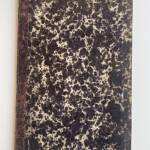
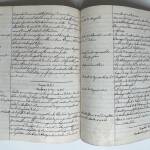
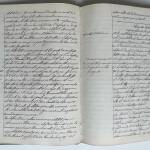
Over 200 pages on paper. Contemporary vellum binding, spine lettered in ink. Text block in excellent condition throughout with minor age toning consistent with a manuscript of this date. Ruled pages. Multiple annotating hands in ink throughout the chronicle section; one later hand in pencil. Folio format.


“This copy was acquired at the Feast of Saint Michel at Loches, 1504, by Michel Bastard, purchased from Pierre Moreau of Loches, and by him given and offered to the Royal republic Lochois, his sacred patrie, praying Monsieur Pierre Dalomeau (Dalomian?), Lieutenant General at Loches, to keep and communicate it until the first opportunity of printing.”


Bias
Omnia quae dixi mecum porto, videtur
sapientem, non habuisse Bias.
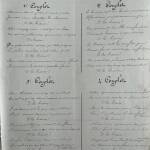
Pro mortuo epitaphium
quid fuit, est et erit? si quis vult dicere, dicam:
spuma fuit, fumus est, putrefiet humus.
Translation
Bias
“All that I have said, I carry with me,” it seems—
the wise man Bias possessed nothing.
Epitaph for the dead
What was he, is he, and will he be? If anyone wishes to say it, I will say it:
He was foam, he is smoke, he will decay into earth.

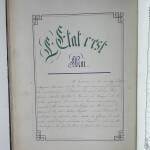
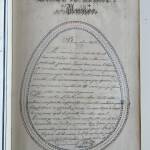
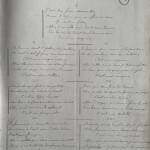
Histoire de Frere Hervé de la Queue Jacobin, trouvé pres Loches l’an
M.D.XXXVIII.

En laquelle sont contenues des antiquités
d’Amboise, Loches, Beaulieu, Blois, Cangy,
Chatauden etc. y a un ample discours
sur les annales de France et d’Amien.


History of Brother Hervé de la Queue, a Jacobin, found at Loches in the year 1538.

In which are contained the antiquities of Amboise, Loches, Beaulieu, Blois, Cangy, Châteaudun, etc., and in which there is an ample discourse on the annals of France and of Amiens.

To René Rocher,
a gift from Gobreau,
vicar ordinary of Loches,
1740.

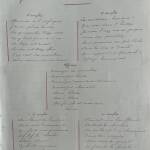
Dedicatory sonnet
of this old historian newly discovered
To the learned Dalonéans and their four noble brothers,
To all magistrates and citizens of Loches,
Indeed to all natives of Touraine and good Frenchmen,
By the great Henry IV, returned from miseries,
This work is dedicated, wherein are many histories
And accounts, in a brief style conforming to Aquinas.
For its themes (according to common understanding and voice)
By divine testimony are of ancient brethren,
Heroic, in shadow, both
of Amboise and of Loches,
And other such captains and faithful men,
Setting forth this collection of histories and deeds,
Above all of the holy prelate of Touraine, Gregory,
Who founded and caused to be engraved, preserving memory
Of our kings, so that nothing should be lacking.

Gobreau addition

Of the town, castle, and royal seat of Loches.
The town of Loches, situated in Touraine on the river Indre, is a place belonging to the ancient patrimony of the first counts of Anjou; the castle served as their residence, the keep as its guard, and the lodging for their prisoners, where all their dignities were once seen.
Now the castle is so spacious in its site, so remarkable in beauty, so pleasant in its situation, and so strong in its defenses, that it has scarcely its equal in the whole kingdom. Artifice and nature together have given this fortress the reputation of being one of the strongest, finest, and best positions in France.
It was held in such esteem during the height and authority of the English among us, as if it had belonged to England itself, for fear of harm, sheltered alike from the blows of the sky and the violence of the earth. The king of England himself, to whose fortune even impossible things were for a time made possible, admitted and confessed frankly that it was impregnable. It stands upon the summit of a high rock; its ditches fall steeply on all sides, and especially on one side where the mountain of Vignemont, which formerly lay contiguous to it, is now removed at a distance of about three hundred paces in length and twenty in width. Its defenses consist of several large towers and bastions.


Dedication

Dedicatory Epistle
To the most noble and most puissant lady, my Lady Jeanne d’Amboise, lady of Renel and of Tifauges, Brother Hervé de la Queue, of the Order and convent of the Friars Preachers of Paris, humbly presents his recommendation to you, wishing that the grace in this world and glory in the next may increase the nobility of your lineage and the devotion which you bear toward the religion of Saint Dominic, desiring that I might, in the service of the said Friars, be able to do something that might please you. Thus, I, your humble friar and obedient servant, most devoted, and because I have understood that you desireto have in French the lineage of the lords of Amboise, and from what time and by which lords and by what merits they were received into this land, I have undertaken to compose and present this present book, divided into sixteen principal chapters (There are actually eighteen chapters), of which the first principally treats of the foundation of the château of Amboise and contains eleven sections.


Discovery

At the castle called Le Chastellier was found an old book written on parchment whose cover was entirely worm-eaten, which by the noble Jacques Lemargnay, Seigneur de la Tourmelière, was given to Master Jehan Moreau, Advocate of Loches, who seeing that it contained many antiquities of Touraine and surrounding regions worthy of being known (which are unknown to many) had a copy made of said book in the year 1538, in which copy no alteration has been made except in the spelling of certain French words which are now written and pronounced differently, though several have been left as written as they were found in said book, and to more easily find the things contained in said book a table has been made which follows.

The Chronicle

Chapitre Premier Opens with Julius Caesar crossing the Alps into Gaul, received peacefully by the Allobroges (now Maurienne and the region to the Saône). Then moves to Lyon, where the Prince of Vienne subjugated all peoples from the Rhône down to the Loire — at that time no castles existed, only earthworks, towers and ditches — and there he found a people called the Auvergnats.

Le Dixhvictiesme Chapitre The heading of chapter 18: contient le voyage d’oultre mer avec tout plain d’aultres choses et contient quatres Parties. — Contains the voyage overseas with much else and contains four Parts.

Opens dramatically: L’an de Grace mil quatre vingt seize Urban ce Pape vint en France et tint concile general en Auvergne avec moult de evesques et d’Abbes de France… — In the year of Grace 1096 Pope Urban came to France and held a general council in Auvergne with many bishops and abbots of France, and preached the word of God, showing the great lords the great suffering of Christians overseas. Many great lords wept and asked leave to take the cross. Among the nobles were Hue de Chaumont and Haymen de Chinoy — both Loire valley lords — who took the cross in the presence of the Pope in the church of Saint Martin de Meremonstrée.

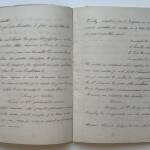
The marginalia

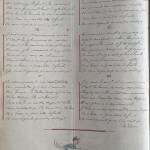
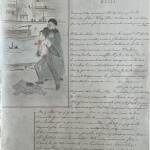
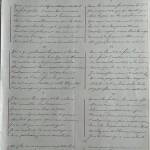
The manuscript is a richly layered historical and genealogical compilation centered on Touraine, particularly Loches and Amboise, and attributed to Frère Hervé de la Queue, a Dominican of Paris. Composed in the sixteenth century and later copied in 1604, the text combines lineage, local antiquities, and legendary historical narrative. It reflects a distinctly early modern antiquarian impulse: to construct a continuous and dignified past for a noble house—here the Amboise family—by weaving together feudal memory, regional topography, and episodes drawn from both history and tradition.

Yet the manuscript’s significance lies not only in its original text but in the visible record of its readership over time, preserved in numerous annotations and inscriptions in different hands. These marginalia transform the volume from a static historical account into a dynamic object of study, revealing successive layers of interpretation.

Several annotations, written in a firm and darker hand, attempt to clarify and correct the narrative historically. These include chronological notes referencing figures such as King Henry I and episodes involving the Huns, often accompanied by precise—if not always accurate—dates. Such interventions suggest a reader concerned with reconciling the manuscript’s semi-legendary material with a more structured historical framework, indicative of a developing critical approach to history in the seventeenth century.

Other marginal notes, in a lighter and more cursive hand, provide learned commentary of an ethnographic or antiquarian nature, linking peoples such as the Huns to broader historical categories like the Scythians or Tartars. These reflect an effort to situate the text within a wider intellectual tradition, drawing on classical and early modern historical knowledge. In contrast, brief annotations identifying places—such as the note locating Montrichard in Touraine—demonstrate a more practical engagement, grounding the narrative in recognizable geography.

The manuscript also contains personal and ownership inscriptions in distinct hands, further attesting to its circulation. The note “don de Gobreau,” identifying a vicar of Loches, and the presentation inscription to René Rocher (1740)indicate ecclesiastical ownership and transmission. A separate inscription dated 1744 naming Gobreau, prior of Saint-Laurent de Loches, reinforces this clerical provenance. Additionally, later scribbles and signatures—some bold and ornamental, others hurried—suggest continued handling, perhaps in a monastic or scholarly setting, where the manuscript remained an object of reference rather than mere preservation.

Notably, the closing pages include annotations in yet another hand, possibly earlier, that comment directly on the act of copying and transmission, including references to the 1604 copy and later additions. These remarks underscore the manuscript’s identity as a copied and recopied text, shaped not only by its original author but by those who preserved, annotated, and reinterpreted it.

Taken together, the presence of multiple hands—differing in ink, script, and intent—reveals a continuum of readership extending across at least two centuries. Each reader approached the manuscript differently: some as historians seeking accuracy, others as scholars contextualizing its content, and still others as custodians marking ownership and transmission. The result is a document that embodies not only the historical imagination of its original composition but also the evolving intellectual engagement of its readers. It stands as both a regional chronicle and a witness to the ongoing process by which historical texts were read, corrected, and understood in early modern France.

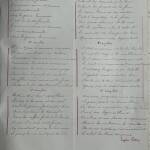
Epitaph….
 (name partly obscured by heavy penwork)

Of the Austrian princes, here lies the last,
Too late for his honor, too soon for his family.
While awaiting an heir,
This prince found it better to leave to his daughter
An inheritance in the air, rights that are disputed.
A husband stripped of the goods of his ancestors,
Of a hundred brilliant titles, the pompous smoke,
Without money, without counsel, without friends, without an army.

early pencil note erroneously stating: “copie faite en 1604 d’un manuscrit de 1158 environ, XIIᵉ siècle,” indicating the text was believed to derive from a 12th-century source

Contemporary vellum binding stiffened with printer’s waste from a Lyon legal text, circa 1490–1530, probably a commentary on the Digest or the Speculum Iudiciale of Guillaume Durantis — consistent with the professional library of Jehan Moreau, Advocate of Loches, in whose household the binding was almost certainly made.


The collector Claude Aubron fits into the history of the Royal Library during the French Revolution, at the departmental level rather than the directorial one — he was not running the library but working within one of its specialized departments, genealogy. His career maps onto the Revolutionary period as follows:

He worked as chief clerk under Delacour in the Département des titres et généalogies, which had been reinstated in 1763. This means his active career at the library ran through the administrations of Le Noir (1784–89) and Le Fèvre d’Ormesson (1789–92) — the last two directors before the Terror. He would have been a working employee of the library during the opening years of the Revolution, watching the successive upheavals in the directorship from below.

Then in 1792, when Le Fèvre d’Ormesson was still director and before his arrest and execution, the abolition of the nobility brought the direct suppression of Aubron’s own department. His institutional career ended not by the guillotine but by decree — the very subject matter of his department, the genealogical records of the French nobility, was rendered politically toxic overnight.

What makes his story particularly poignant is the fate of those around him. His director Le Fèvre d’Ormesson was executed in October 1793. His department’s collections were barricaded behind a pile of chairs to protect them from destruction. Aubron himself survived, retired into private life, and spent the remaining decades of his long life building the private library that came to sale in 1840 — including, as lot 890, this manuscript. He died the year the library’s governance was finally restabilized under a single administrator, having outlived the entire Revolutionary generation of his colleagues.

He is, in short, together with this manuscript, a quiet survivor of one of the most violent episodes in French cultural history — a man who spent his career organizing the records of a nobility that was abolished, and then spent his retirement collecting the kind of regional historical manuscript that his suppressed department had been designed to preserve.


Guillaume Postel letter to Pierre Moreau

Apographe ou Extrait de la Grammaire Gallique de Ian Moreau Lochois

Marginalia

Provenance

Exact list of one hundred masterpieces of art chosen by French Commissioners to be transported from Rome to Paris, following the Treaty of Bologna(*), of 3 Messidor, Year 4 [June 21, 1796]

(*) An armistice was signed in that city; but the Peace Treaty was negotiated and signed at Tolentino on 1st Ventose Year 5 (February 19, 1797.)
Art. 7. The Pope renounces in perpetuity, cedes and transfers to the French Republic all his rights over the territories of the legations of Bologna, Ferrara and Romagna… Art. 13. Article 8 of the armistice treaty signed at Bologna concerning manuscripts and art objects will have its complete and most prompt execution possible.
1st Apollo… 2nd Laocoön… 3rd Torso… 4th Mercury called the Antinous… 5th Hercules with a child in his arms… 6th Demosthenes seated…
 
7th Trajan seated… 8th Menander seated… 9th Posidonius seated… 10th A warrior, called the Phocion… 11. Ariadne called the Cleopatra… 12th Two cupids, half-figure… 13th A Philosopher believed to be Sextus of Chaeronea… 14th Health… 15th Juno… 16th Venus crouching… 17th Adonis…18 Paris… 19th Discobolus… 20th Another Discobolus…21 Bearded Bacchus, called the Sardanapalus…22. Augustus 23rd A veiled Roman… 24th The Cybele of Capri. 25th Meleager… 26: & 27 The Nile and the Tiber, colossal figures… 28th Ceres, colossal… 29th Melpomene same… 30th Apollo musagetes…31 to 39th The nine Muses found at Tivoli… 40th A small seated Urania… 41st A small Clio.

Capitoline Museum: 42nd Eq[uestrian statue] the large one… 43rd Antinous… 44th Apollo with a griffin… 45th Cupid and Psyche… 46th A dying Gladiator… 47th A Faun playing the flute… 48th A young woman holding an urn in her hands… 49th Juno… 50th Venus… 51st Flora… 52nd Antinous… 53rd The philosopher Zeno

From the Palace of the Conservators: 54th The young man pulling a thorn from his foot