
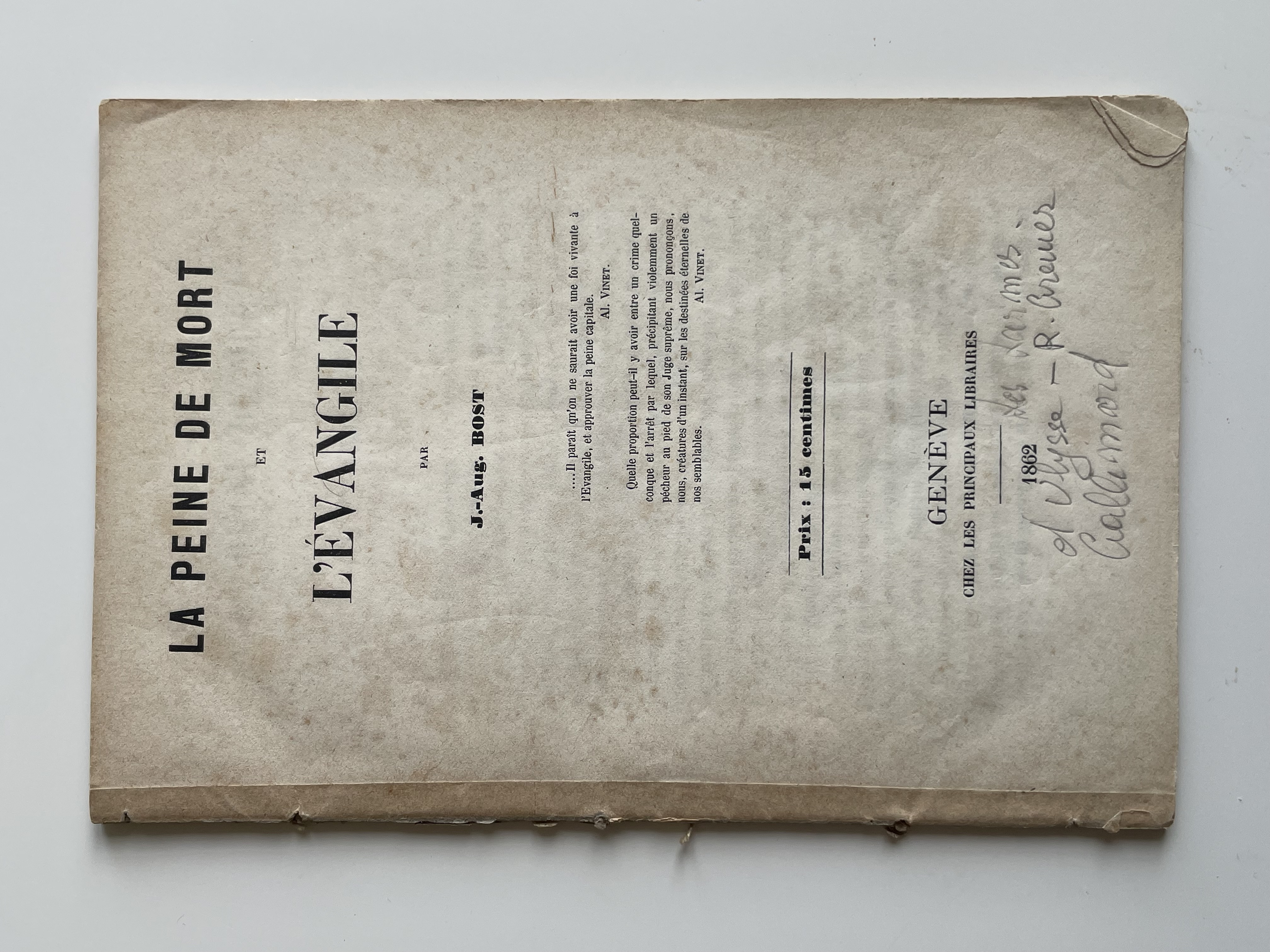
Geneve, chez les principaux libraires, 1862. Thin pamphlet by J.-Aug. Bost, here bound with related tracts forming a sammelband of abolitionist writings, including sections titled Encore une fois plus d’exécution capitale à Genève, Le bourreau, Notes sur l’assassinat légal, Raisons chrétiennes contre la peine de mort (Nos. 1–2, second edition), Lettre à Monsieur le bourreau, and Une exécution capitale ou la conscience publique, dated 24 avril 1862. Imprint references include Geneva printers Pfeffer et Puky and Bonnant. A strongly argued Protestant critique of capital punishment rooted in evangelical morality, reflecting mid-19th century Swiss debates on penal reform.









Issued at a moment when Geneva and the Swiss cantons were actively debating penal reform, these tracts belong to the wider 19th-century European movement toward the restriction and eventual abolition of the death penalty. Since the late 18th century, thinkers such as Beccaria had challenged capital punishment on rational and humanitarian grounds, and by the mid-1800s Protestant circles in Switzerland and France were recasting the argument in explicitly religious terms. Bost’s text reflects this shift, invoking the Gospel to oppose what he calls “l’assassinat légal,” and situating execution as a relic of medieval justice incompatible with modern Christian conscience. The references to recent executions at Geneva indicate a local controversy, where public spectacles of punishment were increasingly criticized as demoralizing and unjust. Such pamphlets, cheaply printed and widely circulated, were instrumental in shaping public opinion during a transitional period that would, over the later 19th century, see many European states reduce or abandon capital punishment.
In the decades following this 1862 publication, abolition advanced unevenly but steadily across the world. Venezuela had already abolished the death penalty for all crimes in 1863, becoming the first modern state to do so; Portugal followed for civil crimes in 1867, and the Netherlands abolished it in 1870. In the Americas, Costa Rica (1877) and Brazil (effectively by the late 19th century for ordinary crimes) moved toward abolitionist practice. In Europe, Italy abolished the death penalty in 1889, while Switzerland itself, after periods of cantonal variation, abolished it at the federal level for peacetime crimes in 1874 and definitively in 1942. The early 20th century saw further progress: Norway (1905, completed 1979), Sweden (1921), and Denmark (1930) abolished it for ordinary crimes, while many Latin American countries followed suit.
After the Second World War, abolition became increasingly associated with human rights frameworks. The United Kingdom abolished the death penalty for murder in 1965 (fully in 1969), France in 1981, and Canada in 1976. Internationally, treaties such as the European Convention on Human Rights (Protocol No. 6 in 1983 and Protocol No. 13 in 2002) and the Second Optional Protocol to the International Covenant on Civil and Political Rights (1989) accelerated abolition. By the late 20th and early 21st centuries, most European countries, as well as large parts of Latin America, had abolished capital punishment entirely. Today, over two-thirds of the world’s countries have abolished the death penalty in law or practice, marking the long trajectory of reform to which Bost’s Geneva pamphlets belong.
Below is the list of countries where the death penalty is still being applied with a caveat for Russia, Sri Lanka and South Korea.
United States, China, Iran, Saudi Arabia, Iraq, Egypt, Somalia, South Sudan, Sudan, Yemen, Libya, Algeria, Morocco, Tunisia, Botswana, Zimbabwe, Belarus, Russia moratorium, Afghanistan, Pakistan, India, Bangladesh, Sri Lanka retention, Japan, North Korea, South Korea moratorium, Taiwan, Indonesia, Malaysia, Singapore, Vietnam, Thailand, Myanmar, Laos, United Arab Emirates, Qatar, Kuwait, Bahrain, Oman.
United States — death penalty status by state (current landscape)
States with active death penalty (executions carried out in recent years)
Alabama, Arizona, Florida, Georgia, Idaho, Indiana, Mississippi, Missouri, Ohio, Oklahoma, South Carolina, Tennessee, Texas, Utah
States retaining the death penalty but with a moratorium or no recent executions
California (governor’s moratorium since 2019), Oregon (moratorium), Pennsylvania (moratorium), Nevada (no executions since 2006), Montana (no executions since 2006; limited by court rulings), Wyoming (no executions since 1992; de facto non-use), Kentucky (no executions since 2008; litigation delays), North Carolina (no executions since 2006; legal challenges)
States that have abolished the death penalty
Alaska, Colorado, Connecticut, Delaware, Hawaii, Illinois, Iowa, Maine, Maryland, Massachusetts, Michigan, Minnesota, New Hampshire, New Jersey, New Mexico, New York, North Dakota, Rhode Island, Vermont, Virginia, Washington, West Virginia, Wisconsin
Federal and military
United States federal government retains the death penalty (last executions carried out in 2020–2021, currently paused under policy review)
U.S. military law also retains capital punishment (rarely used)